

|
Hengdian Group DMEGC Magnetics Co. ,Ltd (002056.SZ): PESTLE Analysis [Apr-2026 Updated] |
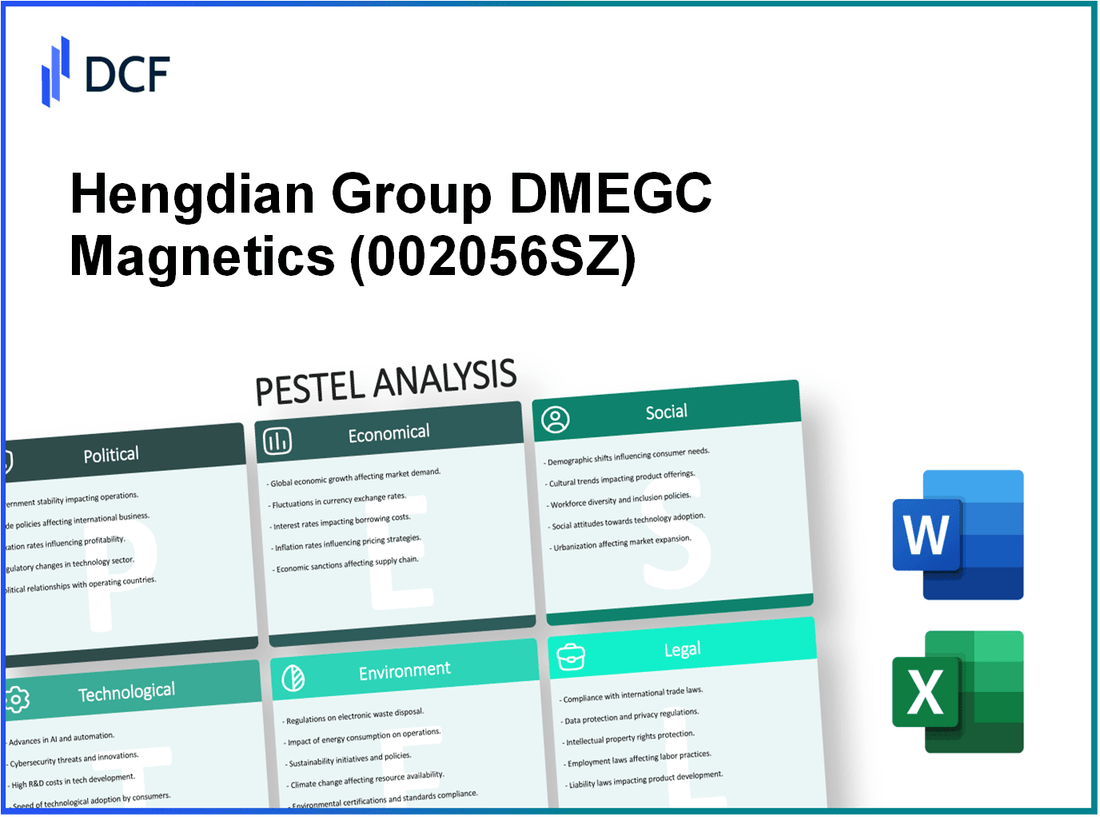
Fully Editable: Tailor To Your Needs In Excel Or Sheets
Professional Design: Trusted, Industry-Standard Templates
Investor-Approved Valuation Models
MAC/PC Compatible, Fully Unlocked
No Expertise Is Needed; Easy To Follow
Hengdian Group DMEGC Magnetics Co. ,Ltd (002056.SZ) Bundle
DMEGC sits at a pivotal crossroads: its integrated supply chain, N‑type module pivot and proximity to booming domestic green infrastructure give it a powerful home‑market advantage and R&D talent pool, while cost leadership and digital automation can fend off intense price pressure; yet rising compliance burdens, an aging labor force and weak PPI margins expose vulnerabilities as rare‑earth export controls, Western tariffs, stricter carbon accounting and PV overcapacity threaten margins-making the company both a beneficiary of China's energy investments and a target for geopolitical and technological disruption, a story worth unpacking.
Hengdian Group DMEGC Magnetics Co. ,Ltd (002056.SZ) - PESTLE Analysis: Political
Rare earth export controls tighten global magnet supply chains
China's tightening of export controls, strategic licensing and stricter customs scrutiny for rare earths and associated processing materials has increased geopolitical risk for downstream magnet manufacturers worldwide. Policy-driven export restrictions contribute to supply volatility for NdFeB (neodymium-iron-boron) and SmCo magnets, elevating price volatility-spot prices for key rare earth oxides have shown intra-year swings of 10-40% in recent market cycles-and extending lead times from months to >6 months for some processed materials.
China's 90% refining capacity locks in domestic supply security
China accounts for approximately 85-95% of global rare-earth refining and separation capacity. This concentration gives Chinese magnet manufacturers, including Hengdian Group DMEGC Magnetics (002056.SZ), preferential access to domestic feedstocks and refined intermediates, supporting vertical integration and cost advantages. Domestic refining dominance effectively lowers internal procurement risk: domestic sourcing can cover >70% of annual NdPr requirements for leading Chinese magnetmakers during constrained export periods.
Energy sovereignty drives massive state-backed grid and PV demand
Chinese central and provincial policies prioritizing energy security and renewable buildout-grid upgrades, large-scale PV and wind installations, and electrification of transport-create sustained state-backed demand for magnets used in wind turbine generators, EV motors and power electronics. Government budget commitments in multi-year plans translate into forecastable off-take: for example, targets to add several hundred gigawatts of renewables over 5 years increase domestic magnet demand by an estimated mid-double-digit percentage versus the prior five-year period.
Five-Year Plan reinforces green subsidies and private-sector dialogue
The 14th and 15th Five-Year Plan policy frameworks emphasize carbon peaking/neutrality, advanced manufacturing and technological self-reliance. This reinforces subsidies, preferential procurement and research grants for energy-efficient motors, rare-earth recycling and domestic supply chain upgrades. Ongoing government-industry consultation mechanisms (industry associations, pilot zones) enable Hengdian Group DMEGC to participate in pilot subsidy programs, standards committees and technology roadmaps that may unlock R&D funding and preferential procurement contracts.
Trade protectionism pushes dual domestic-foreign market strategies
Escalating trade tensions and import tariffs in several major markets have prompted Chinese magnet exporters to pursue dual-track strategies: deepen domestic sales via state-led infrastructure projects and diversify overseas presence through local partnerships, production hubs or downstream component supply agreements. Tariff and non-tariff barriers have increased compliance costs-estimated to add 2-8% to unit costs depending on target market-which incentivizes localization or strategic alliances abroad.
| Political Factor | Direct Impact on DMEGC | Quantitative Indicators | Strategic Implication |
|---|---|---|---|
| Rare-earth export control tightening | Higher export risk for non-domestic buyers; price volatility | Spot price swings 10-40%; lead times >6 months for processed materials | Prioritize domestic supply, stockpiling, and long-term supplier contracts |
| Domestic refining concentration (~90%) | Preferential domestic feedstock access; cost advantage | China share of refining capacity: ~85-95% | Maintain vertical integration and process R&D |
| Energy sovereignty & renewables buildout | Guaranteed domestic demand from wind, PV, EV sectors | Planned renewables addition: hundreds of GW over multi-year plans (state targets) | Align product roadmap to wind/EV motor specifications |
| Five-Year Plan green/tech focus | Access to subsidies, standards-setting, and R&D grants | Multi-year policy allocations for green tech; preferential procurement lists | Engage in pilot schemes; pursue government R&D funding |
| Trade protectionism & tariffs | Increased export costs and market access friction | Incremental compliance/tariff cost impact: ~2-8% of unit cost | Develop overseas partnerships, local manufacturing, or supply agreements |
- Mitigation: Secure multi-year domestic and international supply contracts, increase upstream integration into rare-earth processing and recycling to reduce exposure to export controls.
- Opportunity: Leverage state procurement and renewable buildout to capture high-volume contracts; target R&D subsidies for high-efficiency motor magnets with higher margin.
- Compliance: Strengthen customs, export control compliance and tariff planning; implement transfer-pricing and local-content strategies for key export markets.
Hengdian Group DMEGC Magnetics Co. ,Ltd (002056.SZ) - PESTLE Analysis: Economic
Moderating GDP growth with stable macro backdrop supports long-term planning
China's GDP growth moderated to approximately 5.2% in 2023 and consensus estimates for 2024-2025 range 4.5%-5.5%, providing a predictable but slower demand trajectory for industrial products including magnetic components and solar equipment. A stable macro backdrop-steady fiscal stimuli targeted at infrastructure and green energy-allows Hengdian Group DMEGC Magnetics to plan multi-year capex and R&D investments with lower macro uncertainty than during sharp cycles.
Deflation in producer prices squeezes manufacturing margins
Persistent declines in Producer Price Index (PPI) for much of the 2022-2023 period (peak negative year-on-year PPI rates in 2023 around -2% to -3% in China) compress upstream selling prices for magnetics, cores and related components. For manufacturing margin sensitivity, a 1 percentage point decline in output prices can translate into a comparable gross margin erosion for commodity-like components unless offset by cost-cutting.
| Indicator | Recent value / range | Implication for Hengdian DMEGC |
|---|---|---|
| China GDP growth (2023) | ~5.2% | Predictable but slower demand growth for industrial and solar markets |
| PPI change (2023 YoY) | -2% to -3% | Downward pressure on selling prices and margins |
| CPI (2023 YoY) | ~0.7%-1.0% | Low domestic inflation; limited pricing power |
| 1‑yr LPR / Benchmark lending rate (2024) | ~3.65% (1‑yr LPR) | Low financing costs for capex and working capital |
| Global solar module price decline (2022-2023) | ~20%-40% cumulative in certain segments | Volume pressure; need to shift to higher-value products |
Low inflation and easy credit sustain financing for expansion
With consumer inflation subdued (CPI near or below 1% in 2023) and the People's Bank of China maintaining accommodative policy, corporate borrowing rates remain relatively low (1‑year LPR ~3.65%). This environment supports debt-financed expansion: for example, a 500 million CNY factory investment financed at market rates would carry annual interest of roughly 18.25 million CNY at 3.65%, keeping financing manageable versus historical highs.
- Available low-cost credit supports capacity additions and technology upgrades.
- Lower inflation limits pass-through pricing for higher input costs, increasing emphasis on efficiency.
- Access to public incentives for renewable energy manufacturing can reduce effective capex costs by 5%-15% where applicable.
Solar overcapacity prompts shift from volume to value in production
Global and Chinese solar overcapacity-characterized by module and cell production exceeding near-term demand-has driven sharp price competition (module price drops of 20%-40% in some intervals). Hengdian Group DMEGC Magnetics faces margin pressure in solar-related components and must prioritize higher-margin value-added products (e.g., specialized magnetic materials, integrated assemblies, low-loss inductors) and services (custom design, system-level integration) rather than competing on commodity volume alone.
Volatile external trade requires diversification of export markets
Export volatility driven by tariffs, anti-dumping investigations, logistics disruptions and currency fluctuations increases execution risk for export-oriented revenues. Recent trade frictions (e.g., tariffs / investigations in multiple jurisdictions) and a stronger US dollar at times create uneven demand. Strategic diversification across APAC, Europe, Africa and emerging markets reduces single-market exposure; hedging and local footprint expansion (joint ventures or overseas plants) mitigate trade barrier impacts.
- Risk metric: export share >30% increases sensitivity to trade policy shifts.
- Suggested mitigation: target revenue mix with at least 40% from diversified non‑US markets within 3 years.
- Working capital: longer receivable days from new markets may increase financing needs by an estimated 10%-20% of current working capital.
Hengdian Group DMEGC Magnetics Co. ,Ltd (002056.SZ) - PESTLE Analysis: Social
Demographic shifts are reshaping Hengdian Group DMEGC Magnetics' labor supply and cost structure. China's population is aging: the share of people aged 65+ rose to approximately 14-15% of the population (2022-2024 range), reducing the available young labor pool and increasing pressure on social welfare. This dynamic accelerates automation adoption in manufacturing: capital expenditure on automation and robotics in Chinese electronics and magnets-related factories has been growing at an estimated CAGR of 8-12% in recent years. Wage pressure for experienced technical workers is rising-annual real wage growth for skilled manufacturing workers in eastern China has averaged around 4-7% over the last five years-prompting DMEGC to prioritize automation, advanced process controls, and higher-skilled technician recruitment.
Urbanization trends concentrate skilled talent and expand demand for advanced infrastructure that uses high-performance magnetic components. China's urbanization rate reached about 66-68% by 2022-2024, creating clusters of engineering and R&D talent in coastal and Tier-1/2 cities. These urban clusters correlate with higher demand for green infrastructure (public transit electrification, renewable energy grid components) that rely on high-performance magnets. DMEGC's capacity to place R&D centers and higher-margin assembly operations in urban hubs supports faster product development cycles and access to university-led research partnerships.
Rising education and literacy levels are driving innovation intensity in magnetics. China's gross tertiary enrollment ratio exceeded 50% in recent years, and the number of engineering graduates trained in materials science, electrical engineering and power electronics has been increasing by roughly 5-8% per year. This creates a growing pool of researchers and engineers able to work on high-flux rare-earth magnets, soft magnetic materials, and advanced motor components, enabling DMEGC to increase R&D output. Company-level indicators: DMEGC's R&D expense as a percentage of revenue has trended upward (company disclosures show an increase from low-single-digit percent levels to mid-single-digit percent levels over recent reporting periods), and patent filings in magnetic materials and motor components have risen correspondingly.
Sustainability preferences and the transition to new energy vehicles (NEVs) materially expand addressable markets for DMEGC products. China's NEV sales growth has been strong-NEV vehicle sales accounted for roughly 20-30% of domestic new passenger vehicle sales in recent years, with absolute annual NEV sales in China measured in the low- to mid-millions (several million units per year). Electrification drives demand for permanent magnets, motor cores, and power-electronics-grade magnetic materials. Concurrently, household and corporate green consumption is rising: surveys indicate a growing share of consumers willing to pay premiums (5-15%) for greener products, increasing OEM demand for certified low-carbon supply-chain partners.
Social value alignment-sustainability, corporate responsibility, and product safety-heightens the importance of green branding and supplier ESG credentials. Institutional and retail investors increasingly screen for ESG metrics: environmental/social/governance-related funds have seen inflows and a higher weighting of sustainability disclosures in valuation models. For suppliers like DMEGC, measurable social metrics (employee safety incident rates, local employment contributions, community engagement spend) and environmental metrics (Scope 1-3 emissions intensity per tonne of magnet product) affect contract award decisions from major automakers and renewable-energy integrators.
| Social Factor | Key Metrics / Data | Direct Impact on DMEGC |
|---|---|---|
| Aging population | Population 65+ ≈ 14-15% (2022-2024); shrinking youth labor pool | Increases automation CAPEX; higher wages for skilled labor; upskilling programs required |
| Urbanization | Urbanization rate ≈ 66-68%; concentration in Tier‑1/2 cities | Better access to engineering talent and R&D partners; higher local demand for green infrastructure |
| Education & literacy | Tertiary enrollment >50%; engineering graduates growth ~5-8% p.a. | Increases R&D capacity; faster innovation in high-performance magnets; higher patenting |
| NEV & sustainability demand | NEV share of new car sales ≈ 20-30%; annual sales in multi‑millions | Expands market for permanent magnets and motor cores; revenue growth potential in EV supply chain |
| Social value alignment / ESG | Premiums for green products 5-15%; growing ESG fund allocations | Necessitates green branding, emissions reporting, and supplier ESG certification to win contracts |
Operational and strategic implications for DMEGC include:
- Accelerate automation investments (robotics, Industry 4.0) to offset demographic labor constraints and raise productivity.
- Locate R&D and high-value operations near urban talent clusters to reduce time-to-market and attract skilled staff.
- Increase R&D spend and recruit materials-science and power-electronics engineers to capitalize on NEV and renewable-energy demand.
- Develop verifiable green products and supply-chain transparency (certifications, lifecycle carbon intensity per product) to meet OEM and investor expectations.
- Enhance employer branding, training programs, and wage competitiveness to retain skilled workers amid tightening labor markets.
Hengdian Group DMEGC Magnetics Co. ,Ltd (002056.SZ) - PESTLE Analysis: Technological
N-type dominated PV technology and high-efficiency modules prevail. N-type mono wafers (TOPCon, n-PERT) achieved commercial module efficiencies of 22.5%-24.5% at cell level and 20.5%-22.8% at module level in 2024, representing a ~1.5-2.5 percentage-point premium over p-type PERC in cost-adjusted levelized-cost-of-energy (LCOE). For Hengdian/DMEGC - a supplier of magnetics and components for PV inverters and module manufacturing equipment - higher system voltages (1500V+), larger string currents, and increasing adoption of bifacial n-type modules drive demand for higher-specification inductors, common-mode chokes and low-loss ferrite materials. Global PV installations reached ~300 GW in 2023 and are projected ~350-380 GW in 2025, underpinning steady demand growth for downstream magnetics components.
Perovskite-silicon tandems emerge as disruptive, high-efficiency option. Tandem lab efficiencies exceeded 30% (perovskite/Si) in 2024 with roadmap targets of 33%+ by 2026 and commercial pilot costs targeting <$0.20/W manufacturing incremental costs. If perovskite-silicon tandem adoption reaches just 10% of new module production by 2030, inverter topologies and DC-link design requirements will shift (higher voltage/current dynamics, new MPPT behaviors), creating opportunities for magnetics specialization in high-frequency, high-temperature-stable materials and encapsulation-resistant form factors. Time-to-market pressure for component adaptation is estimated at 24-36 months from pilot commercialization.
AI and IoT enable smarter, lower-cost manufacturing and energy management. Industrial AI-driven predictive maintenance, process optimization and yield improvement deliver 5-15% reductions in manufacturing OPEX and 3-8% increases in throughput in electronics and motor component plants. IoT-enabled digital twins and edge analytics in inverter and ESS (energy storage system) installations increase lifetime availability (uptime) by 2-6 percentage points, improving customer economics and enabling premium pricing for 'smart' magnetics embedded with sensors. Hengdian's R&D and digitalization CAPEX allocation was ~3-5% of revenue in recent years; accelerating AI/IoT adoption suggests a target of 6-8% of revenue to remain competitive in automation and product intelligence by 2027.
Advanced storage and power electronics expand magnetics opportunities. Lithium-ion utility-scale storage deployments grew by ~35% CAGR 2020-2023, reaching ~50 GWh installed in 2023; industry forecasts predict 150-200 GWh annual installations by 2030. Higher adoption of bidirectional inverters, DC-coupled systems, and hybrid ESS requires specialized high-power inductors, isolation transformers with low leakage and high thermal stability, and integrated EMI filtering solutions. Power electronics market size for converters and inverters linked to storage is estimated at USD 45-55 billion in 2024, growing to USD 90-110 billion by 2030, implying material demand growth for magnetics components in the mid-to-high single-digit CAGR range.
Rapid tech shifts demand continuous R&D investment and an agile product roadmap. Key performance indicators include: R&D intensity (R&D/revenue) target 6-8% to commercialize new materials and power topologies; product time-to-market ≤24 months for new magnetics matched to inverter revisions; changeover cost reduction target 12-20% via modular manufacturing and flexible tooling. Intellectual property (patent filings) and material qualification cycles (UL, IEC, RoHS, REACH compliance) add lead times of 6-18 months and require sustained engineering headcount. Failure to match cadence risks revenue exposure: technology-mismatch losses for legacy component lines can reach 10-25% of segment revenue within 3 years of system-level shifts.
Technology impacts matrix:
| Technology Trend | Key Technical Requirement | Quantitative Impact | Opportunity for Hengdian DMEGC |
|---|---|---|---|
| N-type high-efficiency PV | Higher voltage rating (1500V+), low-loss cores | +15-25% demand for high-spec magnetics per inverter | Supply high-voltage inductors, ferrite upgrades |
| Perovskite-silicon tandems | Thermal/chemical resistance, new MPPT response | Potential 10% product redesign rate by 2028 | Develop high-temp materials, rapid qualification |
| AI/IoT in manufacturing | Embedded sensors, digital twin compatibility | 5-15% reduction in OPEX; 3-8% throughput gain | Offer sensor-integrated magnetics, predictive service |
| Advanced storage & power electronics | High-power density, EMI mitigation, bidirectional specs | Storage-linked magnetics market +20-30% by 2030 | Target ESS and BESS OEMs with bespoke components |
| Rapid tech shifts | Shorter product cycles, higher R&D intensity | R&D spend target 6-8% of revenue | Increase agile R&D, modular manufacturing |
Implications for manufacturing and go-to-market:
- Shortened product lifecycles require modular line changeover and SKU rationalization to reduce inventory write-offs (target reduce obsolescence losses by 50% over 3 years).
- Strategic partnerships with inverter, ESS and module OEMs to co-develop magnetics can shorten adoption lag to 12-18 months and secure volume contracts representing 10-30% of new product launch volumes.
- Scaling of digital services (predictive maintenance, embedded diagnostics) can create annuity revenue streams; target 5-10% of total revenue from services by 2028.
Key metrics to monitor: R&D/revenue (%), number of qualified new materials per year, average product time-to-market (months), share of revenue from high-efficiency PV and storage markets (%), percentage of magnetics products with embedded sensors or digital interfaces (%), and goodwill/impairment risk from legacy product obsolescence (monetary exposure).
Hengdian Group DMEGC Magnetics Co. ,Ltd (002056.SZ) - PESTLE Analysis: Legal
Comprehensive Energy Law underpins renewables and hydrogen - China's evolving Comprehensive Energy Law (drafted iterations 2020-2024) creates a legal backbone favoring electrification, renewable integration and hydrogen applications. For DMEGC Magnetics, which supplies magnetic components for transformers, inductors and EV powertrains, the law increases demand for low-loss materials and hydrogen-compatible equipment. Estimated impact: potential revenue uplift of 6-12% in power-electronics product lines over 3-5 years if DMEGC captures grid and hydrogen-electrolyzer magnetics share. Compliance investment: one-time R&D and certification spend forecast at RMB 15-40 million to adapt materials and manufacturing to statutory energy efficiency and grid-interconnection requirements.
New carbon accounting and product footprint standards tighten compliance - National and regional carbon accounting rules (including updated Technical Guidelines for Carbon Emission Accounting) plus emerging Product Carbon Footprint (PCF) standards require lifecycle GHG disclosures for industrial goods. DMEGC must implement scope 1-3 accounting systems and PCF for core products. Typical implementation metrics: scope 1-3 baseline measurement for a medium factory yields 25,000-120,000 tCO2e/year; anticipated annual monitoring and verification costs of RMB 1-4 million. Non-compliance fines and market access barriers can amount to 0.5-3% revenue loss for export-dependent product lines.
| Requirement | Implication for DMEGC | Estimated Cost/Impact |
|---|---|---|
| Scope 1-3 Carbon Accounting | Install data systems, third-party verification | RMB 1-4m/year; 25k-120k tCO2e baseline |
| Product Carbon Footprint Labels | Per-product LCA, label issuance | RMB 10k-50k per SKU; affects ~200 SKUs |
| Renewable & Hydrogen Certification | Material & component testing for electrolyzer grids | RMB 15-40m one-time R&D |
CCC and RoHS updates raise mandatory product-certification burden - The China Compulsory Certification (CCC) regime and expanded RoHS-like restrictions broadened to include more electronic components and rare-earth magnet assemblies. For DMEGC, this means additional pre-market testing, supplier traceability and periodic recertification. Operational impacts include extended product time-to-market by 2-6 months and certification costs of RMB 50k-500k per product family. Compliance also increases BOM traceability requirements: expected supplier audit coverage to expand from 40% to 85% within 24 months.
- Certification timelines: 2-6 months additional per new product family.
- Certification cost: RMB 50k-500k per family; aggregate annual compliance budget projected at RMB 2-6 million.
- Supplier audit expansion: from 40% to 85% within 2 years, increasing procurement QA costs by ~0.3-0.8% of COGS.
Energy Conservation Law revisions push digital-era efficiency standards - Revisions to the Energy Conservation Law emphasize energy management systems, mandatory energy audits for large energy users, and digital energy metering. As a large industrial manufacturer, DMEGC faces mandatory energy audits every 3 years, installation of smart meters, and targets for efficiency improvements (typical mandated reductions of 5-10% energy intensity over 3-5 years). Financial consequences: capital expenditure for metering and controls estimated at RMB 10-25 million; annual energy savings potential of RMB 8-20 million (depending on energy prices and implementation rate).
Regulatory focus on safety, labeling, and supply-chain transparency - Authorities are intensifying enforcement on product safety (electrical safety, thermal stability of magnets), accurate labeling (material composition, recycling instructions) and supply-chain transparency (conflict minerals, rare-earth sourcing). Legal obligations include detailed material declarations, periodic safety testing, and public disclosure of sourcing due-diligence processes. Penalties for breaches range from administrative fines (RMB 100k-2m per infraction) to production suspensions and denial of governmental procurement.
| Area | Specific Legal Demand | Operational Effect |
|---|---|---|
| Safety Testing | Electrical/thermal certification, periodic re-tests | RMB 200k-1m/year; increased QC lead times |
| Labeling | Material composition, recycling marks, PCF labels | SKU relabeling costs RMB 5k-30k each; supply-chain data collection |
| Supply-chain Transparency | Conflict mineral and rare-earth due diligence | Audit and traceability systems: RMB 1-3m setup; recurring audit costs |
Hengdian Group DMEGC Magnetics Co. ,Ltd (002056.SZ) - PESTLE Analysis: Environmental
Dual carbon and energy-intensity targets tighten emissions discipline: National policy commits China to carbon peak before 2030 and carbon neutrality by 2060; the 14th Five-Year Plan (2021-2025) sets a ~13.5% reduction in energy consumption per unit of GDP and an ~18% reduction in CO2 intensity by 2025. For Hengdian Group DMEGC Magnetics Co., this translates into measurable operational constraints: reduction targets require a ~10-20% decrease in site-level energy intensity for manufacturing lines over 2022-2025, and annual monitoring of scope 1-3 emissions with year-on-year decreases. The company must allocate capex for efficiency upgrades - estimated incremental capex of RMB 100-300 million over 2023-2027 for energy-efficiency retrofits and process electrification to meet corporate and provincial decarbonization pathways.
Mandatory green power use for heavy industries drives demand: Grid decarbonization policies and green power quota pilots obligate large industrial energy consumers to increase procurement of certified renewable electricity. Provincial targets and mandatory green power for heavy-users expand demand for renewable certificates and direct power purchase agreements (PPAs). Impact metrics and obligations for Hengdian DMEGC Magnetics:
- Target green power share for manufacturing: 20-50% by 2025 in pilot provinces;
- Renewable Energy Certificate (REC) market growth: national RECs issuance up >200% from 2021-2023;
- Estimated additional annual electricity procurement cost if buying unbundled RECs vs. grid power: RMB 5-20 million, depending on PPA pricing.
Water scarcity and drought risk affect plant operations: Manufacturing of magnetic materials and transformers requires consistent process water and cooling. Regional water stress, seasonal droughts, and stricter water-use permitting increase operational risk and compliance costs. Key quantitative exposures:
| Metric | Current Company Exposure / Estimate | Near-term Impact (2024-2026) |
|---|---|---|
| Annual industrial water use (estimated) | 5,000-12,000 m3 per major plant | Potential 10-25% curtailment during severe drought months |
| Water treatment & recycling capex | RMB 10-50 million per plant for tertiary recycling systems | ROI horizon 4-8 years; reduces freshwater draw by 40-70% |
| Regulatory fines / remediation costs | RMB 0.5-10 million per violation historically in province | Likelihood increases with stricter inspections; insurance premiums may rise |
ETS expansion heightens financial incentives for decarbonization: China's national Emissions Trading System (ETS) currently covers power and is slated to expand sector coverage (steel, cement, chemicals, non-ferrous metals). Carbon allowance prices in secondary markets have ranged roughly RMB 40-80/tCO2 in recent years, creating meaningful operating cost exposure and payback calculations for abatement investments. Quantitative implications for Hengdian DMEGC Magnetics:
- Scope 1 emissions baseline (example estimate): 20,000-60,000 tCO2e annually across larger manufacturing sites;
- At RMB 50/tCO2, annual ETS cost exposure could be RMB 1.0-3.0 million before allowance allocation;
- Abatement cost curve: energy-efficiency measures and fuel switching often deliver abatement at RMB 0-200/tCO2 vs. potential ETS costs; large electrification projects shift exposure from fuel to electricity prices and REC procurement.
Ecological-first approach shapes long-term corporate resilience: National and provincial "ecological civilization" directives raise standards for pollution control, biodiversity protection, and land-use constraints. For Hengdian DMEGC Magnetics, strategic responses include embedding circular-economy processes, increasing material recovery rates, and aligning site expansion with ecological red lines. Relevant KPIs and projected benefits:
| KPI / Initiative | Target / Metric | Projected Outcome (3-5 years) |
|---|---|---|
| Material recycling rate (core metals/insulation) | Increase from 40% to 70% | Raw material cost reduction 5-15%; lower waste disposal fees |
| VOC and effluent reduction | ≥30% reduction through process controls and recovery | Reduced permitting risk; lower environmental compliance costs ~RMB 1-5 million/yr |
| Green certification and Eco-labels | Obtain 2-4 product/plant certifications (ISO 14001, green product) | Access to green procurement tenders; premium pricing potential 1-3% |
Disclaimer
All information, articles, and product details provided on this website are for general informational and educational purposes only. We do not claim any ownership over, nor do we intend to infringe upon, any trademarks, copyrights, logos, brand names, or other intellectual property mentioned or depicted on this site. Such intellectual property remains the property of its respective owners, and any references here are made solely for identification or informational purposes, without implying any affiliation, endorsement, or partnership.
We make no representations or warranties, express or implied, regarding the accuracy, completeness, or suitability of any content or products presented. Nothing on this website should be construed as legal, tax, investment, financial, medical, or other professional advice. In addition, no part of this site—including articles or product references—constitutes a solicitation, recommendation, endorsement, advertisement, or offer to buy or sell any securities, franchises, or other financial instruments, particularly in jurisdictions where such activity would be unlawful.
All content is of a general nature and may not address the specific circumstances of any individual or entity. It is not a substitute for professional advice or services. Any actions you take based on the information provided here are strictly at your own risk. You accept full responsibility for any decisions or outcomes arising from your use of this website and agree to release us from any liability in connection with your use of, or reliance upon, the content or products found herein.