

|
Qualys, Inc. (QLYS): 5 FORCES Analysis [Nov-2025 Updated] |
Fully Editable: Tailor To Your Needs In Excel Or Sheets
Professional Design: Trusted, Industry-Standard Templates
Investor-Approved Valuation Models
MAC/PC Compatible, Fully Unlocked
No Expertise Is Needed; Easy To Follow
Qualys, Inc. (QLYS) Bundle
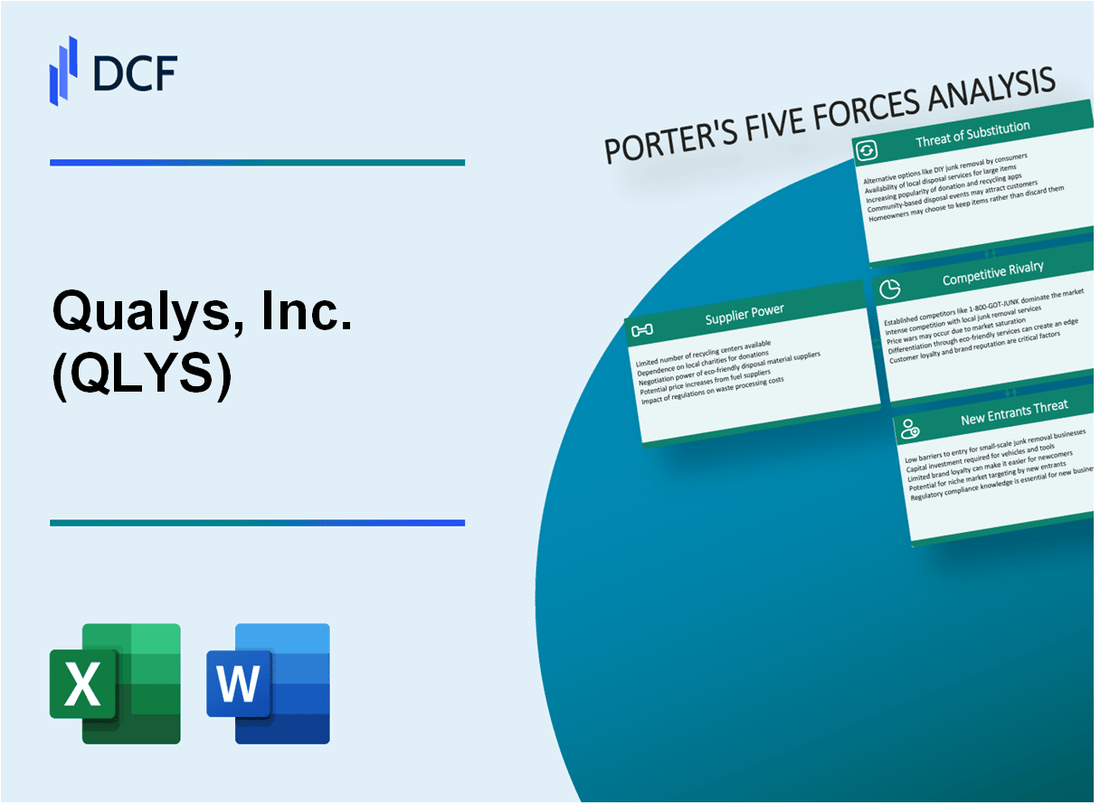
You're assessing Qualys, Inc.'s competitive standing right now, late in 2025, and honestly, the picture is complex: the cloud-native platform shows incredible financial discipline, boasting an 84% Q3 GAAP Gross Margin, but it operates under intense pressure. We need to see if that profitability can withstand the high bargaining power from suppliers like AWS and Azure, and the increasing leverage held by its 212 customers spending over $500,000 annually. Still, the barriers to entry are high, and while rivalry with Tenable and Rapid7 is fierce in this $55 billion Total Addressable Market, understanding where the real friction lies is key to valuing Qualys, Inc. going forward.
Qualys, Inc. (QLYS) - Porter's Five Forces: Bargaining power of suppliers
When we look at the inputs Qualys, Inc. needs to run its business, the power held by its key suppliers is a critical factor. You have to consider the infrastructure providers, the talent pool, and the data sources that feed the platform.
Suppliers of cloud infrastructure like AWS, Azure, and GCP definitely hold significant leverage. These hyperscalers form a market oligopoly, and their pricing and service terms directly impact Qualys's operational costs, even if Qualys, Inc. is a major Independent Software Vendor (ISV) partner. The sheer scale of cloud spending is evident; Canalys estimated that cloud marketplaces, a key distribution channel for Qualys, Inc., would grow to over US$45 billion by 2025. This growth shows the dependence on the underlying infrastructure providers.
Still, Qualys, Inc. shows remarkable internal strength in managing its cost of revenue. For the third quarter of 2025, the company reported a GAAP Gross Margin of 84%. That's a very high number for a software business, suggesting strong control over the direct costs associated with delivering its cloud platform services. This high margin provides a buffer against potential cost increases from infrastructure suppliers.
Here's a quick look at how that profitability stacks up for Q3 2025, which helps you see the internal pricing power:
| Metric (Q3 2025) | Value | Context |
|---|---|---|
| GAAP Gross Margin | 84% | Control over Cost of Revenue |
| Adjusted EBITDA Margin | 49% | High operational efficiency |
| GAAP Operating Income Margin | 35% | Strong core profitability |
| Revenue | $169.9 million | Quarterly top-line performance |
The other major supplier category is human capital. Specialized talent-think cybersecurity researchers who understand zero-day threats or AI engineers who build the next generation of risk scoring-is a scarce, high-cost input. These individuals have strong bargaining power because Qualys, Inc. needs them to maintain its technological edge, especially as it pushes into areas like the Risk Operations Center (ROC) category. If onboarding takes too long, product velocity suffers.
To be fair, the relationship with the major cloud providers isn't purely one-sided. Qualys, Inc. acts as a crucial ISV partner, often driving consumption of the cloud provider's services through its platform. This partnership status mitigates some of the transactional risk you might see with a smaller customer. Furthermore, the core threat intelligence data that Qualys, Inc. ingests and processes is highly differentiated, which limits the number of viable alternative suppliers for that specific, critical input.
The bargaining power of suppliers is therefore a mixed bag:
- Cloud Infrastructure: High power due to oligopoly, but mitigated by Qualys, Inc.'s high gross margins.
- Specialized Talent: High power due to scarcity and high cost in a competitive market.
- Data Inputs: Lower power due to the differentiated and proprietary nature of core threat intelligence.
The fact that Qualys, Inc. serves over 10,000+ subscription customers, including a majority of the Forbes Global 100 and Fortune 100, gives it significant scale when negotiating with vendors who benefit from that large customer base. Finance: draft 13-week cash view by Friday.
Qualys, Inc. (QLYS) - Porter's Five Forces: Bargaining power of customers
You're looking at the leverage your biggest clients hold, and frankly, it's a major factor in Qualys, Inc.'s near-term revenue predictability. Large enterprise customers, including a majority of the Forbes Global 100, are highly sophisticated and definitely demand price concessions. Management noted in their Q2 2025 commentary that they are monitoring the business environment due to ongoing scrutiny of IT budgets among enterprise customers, which contributes to a challenging environment for new business growth in 2025. This pressure is real.
Customer sales cycles have lengthened due to increased budget scrutiny and macro uncertainty. For Qualys, Inc., the sales cycle for their IT, security, and compliance solutions typically ranges from six to twelve months, but it can extend beyond eighteen months, especially for large transactions. This unpredictability in deal timing makes forecasting revenue a tricky business. To be fair, this isn't unique to Qualys, Inc.; nearly half of B2B sales leaders (43%) reported an increase in sales cycle length over the past 12 months as of 2025.
Still, high switching costs exist due to the deep integration of the Enterprise TruRisk Platform into IT workflows. The platform's value proposition centers on consolidating security tools and automating critical workflows, which means ripping it out involves significant operational disruption. For instance, Policy Audit leverages unified agent software to automate evidence collection spanning more than 90 compliance frameworks. This level of embedded automation and workflow orchestration creates stickiness.
The power of the top-tier customers is growing, as evidenced by their expanding spend. The number of customers spending over $500,000 annually grew 7% from a year ago to 212 in Q2 2025, increasing their individual leverage. This cohort represents a significant portion of the total revenue base.
Customers can easily test competitor platforms like Tenable and Rapid7, increasing their negotiation power. CSOs are increasingly looking for platforms that allow flexibility across their security stack while unifying through a common framework, rather than consolidating around a single vendor. This search for flexibility means they are actively comparing offerings, which puts pressure on Qualys, Inc. to justify the platform's value against alternatives.
Here's a quick look at how the high-value customer segment is trending:
| Metric | Value / Period | Context |
|---|---|---|
| Customers spending $\ge$ $500,000 Annually | 212 (Q2 2025) | Represents the highest-spending enterprise segment. |
| Year-over-Year Growth in $\ge$ $500k Customers | 7% (Q2 2025) | Indicates growing concentration of high-value accounts. |
| Typical Sales Cycle Length | 6 to 12 months (Can exceed 18 months) | Reflects budget scrutiny and complexity in large deals. |
| General B2B Sales Cycle Increase Reported | 43% of leaders saw an increase (Past 12 months, 2025) | Market context for lengthened deal timelines. |
The platform's ability to unify risk management and automate compliance evidence collection across numerous standards is key to mitigating this buyer power. For example, the Net Dollar Expansion Rate was 104% in Q2 2025, up from 103% the prior quarter, showing that while new business is scrutinized, existing customers are still expanding their usage, albeit at a slightly slower pace of expansion.
- The platform's unified agent automates evidence collection for over 90 compliance frameworks.
- The Net Dollar Expansion Rate was 104% in Q2 2025.
- International revenue growth (15%) outpaced domestic growth (7%) in Q2 2025.
- Channel partners contributed 49% of total revenues in Q2 2025.
Finance: draft 13-week cash view by Friday.
Qualys, Inc. (QLYS) - Porter's Five Forces: Competitive rivalry
The competitive rivalry facing Qualys, Inc. is undeniably sharp, driven by a set of established, well-funded platform competitors. You are definitely squaring off against heavyweights like Tenable, Rapid7, and CrowdStrike in the security space. This competition is not static; the market is actively shifting its focus from traditional vulnerability management (VM) to broader Exposure/Risk Management (ERM) solutions, which forces a constant feature race to keep up with platform parity and differentiation.
To be fair, Qualys, Inc. is demonstrating superior operational efficiency in this environment. The company posted an Adjusted EBITDA Margin of 49% for Q3 2025, which is a strong indicator of profitability compared to many peers who might be sacrificing margin for top-line growth. This high margin, coupled with a Free Cash Flow Margin of 53% in Q3 2025, suggests capital efficiency even while investing in innovation, like the transition to agentic AI-powered proactive risk management and the Enterprise TruRisk Management (ETM) solution, which management noted can drive up to a 100% uplift versus VMDR.
The battle for enterprise share is concentrated around large, multi-module consolidation deals. Customers are looking to reduce vendor sprawl, so winning these deals means displacing competitors across multiple security functions. This intensity is underscored by the threat landscape itself; for example, the average time to exploit a known Common Vulnerabilities and Exposures (CVE) dropped below 7 days as of IBM's 2024 X-Force report, meaning the speed of the vendor's platform matters immensely to the customer.
Still, the overall market size acts as a significant buffer against the most cutthroat aspects of rivalry. The Total Addressable Market (TAM) for the broader cybersecurity sector was valued at approximately $218.98 billion globally in 2025, indicating a large and growing pie. This scale tempers the zero-sum nature of the competition because there is ample room for growth across the entire ecosystem, even as Qualys, Inc. fights for wallet share against its direct rivals.
Here's a quick look at some of the financial context around Qualys, Inc. as of the end of Q3 2025:
| Metric | Value (Q3 2025) | Context/Comparison |
|---|---|---|
| Adjusted EBITDA Margin | 49% | Demonstrates high profitability and operating leverage. |
| Revenue | $169.9 million | Q3 2025 revenue, representing a 10% year-over-year growth. |
| Free Cash Flow Margin | 53% | Q3 2025 FCF margin, showing strong cash conversion. |
| Partner Revenue Mix | 50% | Percentage of total revenues driven by channel partners. |
| ETM Uplift Potential | Up to 100% | Potential revenue uplift from migrating VMDR customers to ETM. |
The competitive dynamics are also influenced by the channel strategy, which is a key action point for Qualys, Inc. Partner-led sales now constitute 50% of total revenues, up from 47% the prior year, with channel partner revenues growing 17% year-over-year in Q3 2025. This focus helps Qualys, Inc. scale its reach against competitors who may rely more heavily on direct sales forces.
The pressure to innovate is clear, evidenced by management's emphasis on platform evolution:
- Transitioning from Attack Surface Management to Risk Surface Management.
- Integrating Agentic AI-powered proactive risk management.
- Refining ETM pricing/packaging to drive upsell.
- Leveraging TrueConfirm to validate exploitability before compromise.
If Net Revenue Retention (NRR) remains flat at 104%, as noted in Q3 2025, it signals that while customer logos are sticky, the pace of upsell-a critical battleground against platform competitors-remained challenging that quarter.
Qualys, Inc. (QLYS) - Porter's Five Forces: Threat of substitutes
You're looking at the landscape where customers have options outside of the full Qualys platform, and honestly, that's where the real competitive pressure often lies. It's not always about a direct competitor; sometimes, it's about doing nothing or using a cheaper, less integrated alternative.
Customers can choose to use open-source vulnerability scanners like OpenVAS for basic, low-cost scanning. This is a clear substitute for organizations with very limited budgets or those only needing rudimentary checks. To give you a sense of scale, while OpenVAS (via Greenbone) has a substantial feed of approximately 50,000 vulnerability tests, Qualys VMDR boasts coverage of over 190K+ vulnerability detections, covering 98.7% of the CISA Known Exploited Vulnerabilities list as of late 2025.
| Scanner Metric | OpenVAS (Greenbone) Estimate | Qualys VMDR Stated Capability |
|---|---|---|
| Vulnerability Test Count (Approximate) | 50,000 | 190K+ Detections |
| CISA KEV Coverage (Percentage) | Not explicitly stated | 98.7% |
| Target User Profile | Small Businesses (Limited Resources) | Mid-Market to Large Enterprise |
Internal IT/security teams may use native cloud security tools from AWS or Azure instead of a third-party platform for cloud-specific needs. While these native tools provide foundational security, independent testing suggests a gap in core exploit prevention. For instance, in a Q1 2025 evaluation by CyberRatings.org, both AWS and Microsoft Azure cloud network firewalls scored 0% security effectiveness in preventing exploits and evasions, compared to top third-party vendors achieving 100%. Still, the sheer scale of the cloud providers means they are always in the mix; AWS held a 29% share of the global enterprise cloud infrastructure services market in Q3 2025, and Microsoft's Intelligent Cloud group generated $30.9 billion in sales in the same quarter.
The platform's integrated remediation capabilities (TruRisk Eliminate) reduce the appeal of siloed point solutions. This is a key differentiator because remediation is often the bottleneck. For a known critical vulnerability like CVE-2024-1086, anonymized Qualys data showed that only 20% of detected instances were remediated in customer environments, taking an average of 28 days. Qualys TruRisk Eliminate aims to drastically cut that time by automating compensating controls when patching isn't feasible, which directly counters the slow, manual effort associated with using separate tools for detection and fixing.
The substitute threat is low for large enterprises needing a unified, compliance-focused solution. Qualys continues to land and expand with its largest clients; customers spending $500,000 or more annually grew to 211 in Q3 2025. Furthermore, the platform stickiness is evident in the net dollar expansion rate, which remained at 104% quarter-over-quarter in Q3 2025, showing that existing customers are expanding their spend, not cutting back for substitutes. This suggests that for complex, compliance-heavy environments, the cost of switching or managing multiple point solutions outweighs the initial savings of a cheaper substitute.
Using multiple unintegrated security tools is a defintely viable, though inefficient, substitute. We see this play out when customers consolidate. One large government agency, frustrated with the inefficiencies of operating siloed systems and elongated remediation efforts across multiple legacy and next-gen solutions, accelerated the consolidation of its security stack across seventeen Qualys modules, including TruRisk Eliminate. This move highlights that while using separate tools is possible, the operational friction and cost associated with managing that complexity-especially when trying to meet mandates like FedRAMP High-drives customers toward a unified platform like Qualys, which has over 10,000 total subscription customers globally.
- The platform play, exemplified by ETM driving up to a 100% revenue uplift over VMDR, makes the total cost of ownership for a unified stack more compelling than piecemeal solutions.
- The channel's contribution to total revenues reached 50% in Q3 2025, indicating that partners are actively selling the consolidated platform value proposition over individual tools.
- The global Vulnerability Scanning Tools Market is projected to reach $24.51 billion by 2030, but Qualys's strategy focuses on capturing the value from integration rather than just the volume of basic scans.
Qualys, Inc. (QLYS) - Porter's Five Forces: Threat of new entrants
You're looking at the barriers to entry for a new player trying to take on Qualys, Inc. (QLYS) in the enterprise cybersecurity platform space as of late 2025. Honestly, the hurdles are substantial, built on years of investment and regulatory compliance.
The capital barrier to replicate a global-scale, cloud-native platform is very high. Building the necessary data infrastructure and achieving the required global footprint demands significant upfront and ongoing investment. For perspective, while Qualys planned capital expenditures for the full year 2025 to be in the range of $7.0 to $9.0 million, the total cost of ownership for building a comparable, from-scratch cloud-native development infrastructure was estimated to average $5.6 million in a recent analysis, with infrastructure environment costs alone hitting about $2.7 million. That figure doesn't even fully account for the proprietary data accumulation that Qualys has achieved.
Next, you face a steep regulatory wall, especially for government business. Qualys, Inc. secured FedRAMP High Authorization for its Government Platform in 2025. This is the most rigorous level under the Federal Risk and Authorization Management Program, validating compliance with NIST 800-53 High Impact controls. For a new entrant, achieving this independently validated status is a major, time-consuming hurdle that opens access to the federal government's most sensitive systems.
New entrants also struggle mightily to match the proprietary intelligence Qualys has accumulated. Their Threat Research Unit (TRU) is a massive asset. They index over 1+ trillion Data Points and maintain 272,000+ Vulnerability Signatures. Furthermore, their detection capability covers 99.2% of weaponized CVEs. This intelligence feeds their proprietary TruRisk™ Scoring Engine, which uses over 25 threat intelligence feeds to prioritize risk.
The technical barrier is cemented by the requirement for deep, native integration across the entire IT estate. A new competitor must offer seamless integration with existing ITSM tools and diverse cloud environments, which is complex to engineer at scale. Qualys offers a unified platform that spans vulnerability management, compliance, EDR, asset inventory, policy enforcement, and web application security.
Here's a quick look at how these barriers stack up against a hypothetical new entrant:
| Barrier Component | Qualys, Inc. (QLYS) Established Metric/Status | Estimated New Entrant Cost/Time Proxy |
|---|---|---|
| Cloud-Native Scale Investment (Annual) | Planned 2025 CapEx: $7.0 to $9.0 million | High, ongoing operational expense required for global scale. |
| Regulatory Access (US Gov) | Achieved FedRAMP High Authorization (Aug/Sep 2025) | Independent validation against NIST 800-53 High Impact controls is a multi-year process. |
| Vulnerability Intelligence Scale | 1+ trillion Data Points Indexed | Requires years of continuous scanning and data ingestion to match. |
| Weaponized Threat Coverage | 99.2% coverage of weaponized CVEs | New entrants start at 0% coverage for the most critical threats. |
| Platform Breadth | Unified suite: VMDR, EDR, CSPM, WAS, Compliance | Requires developing or acquiring multiple distinct, integrated modules. |
Still, new entrants often find a foothold by focusing on a specific, underserved niche rather than attempting to build the full risk management suite immediately. For example, some startups concentrate solely on areas like API security, such as Akto, or specific cloud security posture management (CSPM) features, rather than the comprehensive, end-to-end platform Qualys, Inc. offers. This niche focus allows them to avoid the massive capital outlay and integration complexity required to challenge the full suite directly, but it limits their immediate Total Addressable Market (TAM) compared to Qualys's broad offering.
Finance: draft a sensitivity analysis on the impact of a new FedRAMP High competitor by next Tuesday.
Disclaimer
All information, articles, and product details provided on this website are for general informational and educational purposes only. We do not claim any ownership over, nor do we intend to infringe upon, any trademarks, copyrights, logos, brand names, or other intellectual property mentioned or depicted on this site. Such intellectual property remains the property of its respective owners, and any references here are made solely for identification or informational purposes, without implying any affiliation, endorsement, or partnership.
We make no representations or warranties, express or implied, regarding the accuracy, completeness, or suitability of any content or products presented. Nothing on this website should be construed as legal, tax, investment, financial, medical, or other professional advice. In addition, no part of this site—including articles or product references—constitutes a solicitation, recommendation, endorsement, advertisement, or offer to buy or sell any securities, franchises, or other financial instruments, particularly in jurisdictions where such activity would be unlawful.
All content is of a general nature and may not address the specific circumstances of any individual or entity. It is not a substitute for professional advice or services. Any actions you take based on the information provided here are strictly at your own risk. You accept full responsibility for any decisions or outcomes arising from your use of this website and agree to release us from any liability in connection with your use of, or reliance upon, the content or products found herein.