
|
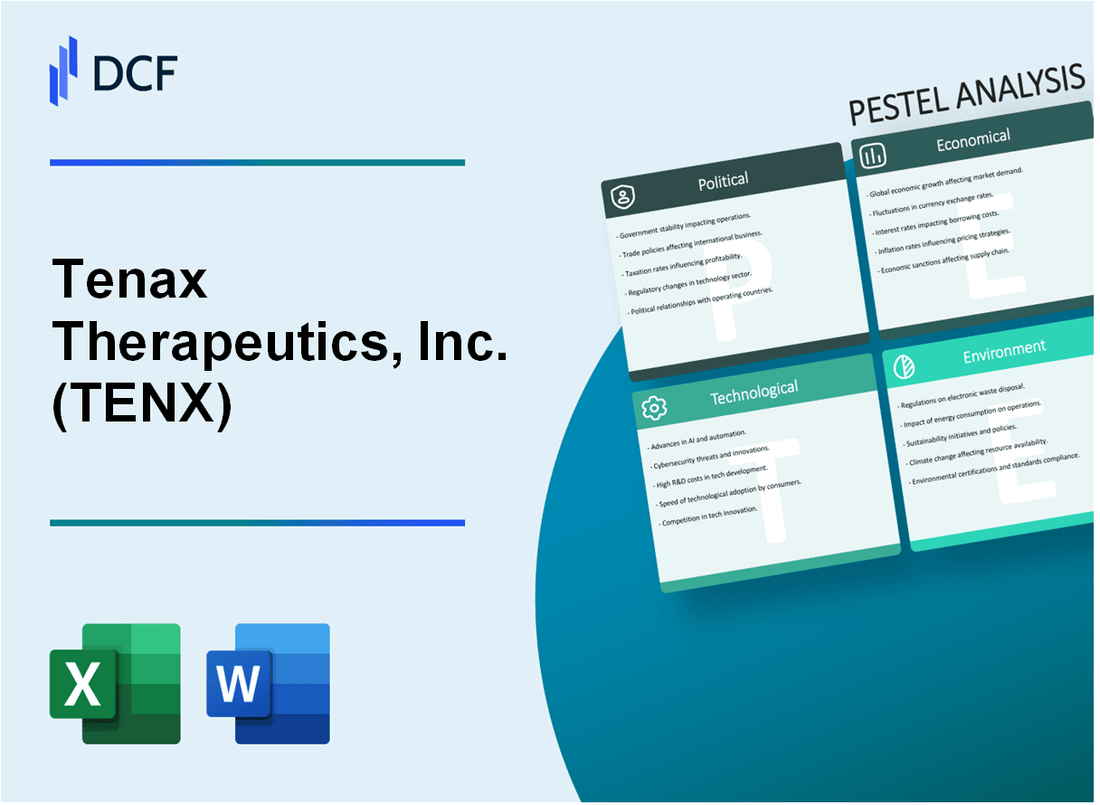
Tenax Therapeutics, Inc. (TENX): PESTLE Analysis [Nov-2025 Updated] |
Fully Editable: Tailor To Your Needs In Excel Or Sheets
Professional Design: Trusted, Industry-Standard Templates
Investor-Approved Valuation Models
MAC/PC Compatible, Fully Unlocked
No Expertise Is Needed; Easy To Follow
Tenax Therapeutics, Inc. (TENX) Bundle
You're holding Tenax Therapeutics (TENX) and need a clear view of the external forces shaping your investment. The reality for this small-cap biopharma is a high-stakes tightrope walk: the US government's push to lower drug prices post-IRA and the average cost of bringing a new drug to market-now exceeding $1.5 billion-create immense political and economic headwinds. But, that risk is balanced by a strong market tailwind, with the specialty cardiovascular drug market projected to grow by about 10% annually through 2025. Success hinges on navigating the FDA's increasing scrutiny and securing favorable payer reimbursement, so we've mapped the full Political, Economic, Sociological, Technological, Legal, and Environmental (PESTLE) landscape to give you a defintely actionable view of TENX's near-term risks and opportunities.
Tenax Therapeutics, Inc. (TENX) - PESTLE Analysis: Political factors
US Government Pressure to Lower Drug Prices and the IRA
You are operating in a political climate where the primary focus is defintely on lowering drug costs, and that pressure directly hits your future revenue model. The most significant piece of legislation here is the Inflation Reduction Act (IRA).
The IRA creates a two-tiered system that puts small-molecule drugs like Levosimendan at a disadvantage compared to biologics. Small-molecule drugs are subject to Medicare price negotiation after only 9 years on the market, while biologics get 13 years. This 'pill penalty' has already shifted R&D incentives, with funding for small-molecule drug development reportedly dropping 70% since the IRA's drug pricing provisions were first drafted. For Tenax Therapeutics, Inc., this means a shorter commercial runway to recoup the substantial investment in your Phase 3 trials.
The Centers for Medicare & Medicaid Services (CMS) is serious about negotiation; the first round of price cuts, starting in 2026, secured reductions between 38% and 79% for the selected drugs. Even if your drug isn't selected immediately, competitors will be expected to match or beat the reduced net price, creating a downward pressure on all pricing.
FDA's Accelerated Approval Pathway Rules Under Scrutiny
The pathway to market is getting tougher, even for drugs treating high-unmet-need conditions like those Tenax Therapeutics, Inc. is targeting. The FDA's accelerated approval pathway is under intense scrutiny, raising the bar for the clinical evidence you'll need.
In early 2025, the Office of Inspector General (OIG) released a report critiquing the FDA's use of the pathway, citing concerns in 3 of 24 reviewed drugs, two of which were later withdrawn from the market. Following this, the FDA released new draft guidance in January and February 2025, reflecting a 'tightening of the reigns.'
The new guidance is clear: confirmatory trials must be considered 'underway' before accelerated approval is granted, with defined milestones and sufficient resources committed. This means your clinical trial planning must be more rigorous and front-loaded than ever before. It's a higher hurdle for small biotechs.
Potential Bipartisan Legislation on Orphan Drug Exclusivity
Your lead candidate, Levosimendan, has Orphan Drug Status for Amyotrophic Lateral Sclerosis (ALS), which should shield it from the IRA's price negotiation. But this protection is becoming a political battleground.
While the 'One Big Beautiful Bill Act' (OBBBA), signed in July 2025, broadened the Orphan Drug Exclusion to protect drugs with multiple orphan indications, a bipartisan group of senators is already pushing back.
In November 2025, legislation was introduced to repeal the blanket exemption for orphan-only drugs if their annual Medicare spending exceeds $400 million. This is a critical risk, especially as Levosimendan is also in Phase 3 for Pulmonary Hypertension with Heart Failure with Preserved Ejection Fraction (PH-HFpEF), a condition with an estimated prevalence of over 2,000,000 patients in North America by 2030. If the PH-HFpEF indication is not considered an orphan disease, the drug's entire market protection could be jeopardized.
Here's the quick math on the political risk factors:
| Political Factor | Impact on Small-Molecule Drug (Levosimendan) | 2025 Data / Actionable Insight |
|---|---|---|
| IRA Price Negotiation | Shorter market exclusivity period. | Small-molecule drugs face negotiation after 9 years (vs. 13 for biologics). First negotiated prices saw cuts of 38%-79%. |
| Orphan Drug Exemption Scrutiny | Risk of losing IRA exemption if Medicare spending is high or if a non-orphan indication is approved. | Legislation introduced in November 2025 targets drugs with over $400 million in annual Medicare spending, regardless of orphan status. |
| FDA Accelerated Approval | Increased regulatory burden for clinical evidence. | New 2025 draft guidance requires confirmatory trials to be 'underway' before approval, tightening standards. |
Geopolitical Tensions and API Supply Chain Disruption
The stability of your supply chain for Active Pharmaceutical Ingredients (APIs) is directly tied to global politics, and 2025 has been turbulent. Geopolitical tensions, particularly involving the US and China, are driving up costs and forcing diversification.
In June 2025, the US administration imposed a 55% consolidated tariff on Chinese imports, replacing the previous 30% rate. This, plus the increase in tariffs on steel and aluminum from 25% to 50%, raises the cost of manufacturing equipment and, consequently, API production.
Also, regional conflicts, such as the Israel-Iran crisis in June 2025, pushed Brent crude oil prices up to $80/barrel, increasing energy and utility costs for all biopharma manufacturing. This directly impacts your cost of goods sold (COGS) and requires a proactive strategy to secure alternative API sources outside of high-risk regions.
- Monitor US-China tariff rates; consolidated tariff on Chinese imports is 55% as of June 2025.
- Factor in higher energy costs; Brent crude surged to $80/barrel in June 2025 due to Middle East tensions.
- Diversify API sourcing to mitigate risk from regional instability.
Tenax Therapeutics, Inc. (TENX) - PESTLE Analysis: Economic factors
You need to know that the economic environment for small-cap biopharma companies like Tenax Therapeutics is a mix of high development costs and a slowly easing, but still restrictive, capital market. The biggest headwind is the sheer expense of bringing a new drug to market, but the tailwind is a large, growing specialty market for cardiovascular treatments.
High inflation and interest rates make capital raising (e.g., secondary offerings) more expensive, increasing the cost of capital.
The Federal Reserve's fight against persistent inflation has definitely kept the cost of capital (the return investors demand for funding your work) elevated in 2025. While the Fed has started to ease, the target Federal Funds Rate was still in the 3.75%-4% range as of October 2025, a level that makes borrowing expensive. This is a critical factor for a pre-revenue company like Tenax that relies on secondary offerings or debt for funding.
Here's the quick math: higher interest rates make future cash flows less valuable in a discounted cash flow (DCF) valuation, which directly pressures your stock price and makes new equity raises (dilutive financing) less attractive. Biotech stocks are inherently interest-rate sensitive because their profits are so far out. Venture capital flow into the broader biotech sector has cooled significantly from its peak, hovering around $5 billion to $7 billion per quarter in 2024-2025, which means less easy money is available.
The average cost to bring a new drug to market now exceeds $1.5 billion, demanding significant cash reserves or partnerships.
The financial barrier to entry is staggering. The average cost to develop a single new prescription drug, factoring in the cost of failed candidates, is now estimated to be around $2.6 billion as of late 2025. You can't just bootstrap a Phase 3 trial. This enormous price tag forces small companies to either maintain massive cash reserves or, more commonly, seek strategic partnerships and licensing deals with larger pharmaceutical companies to share the development burden and risk.
This reality means Tenax must be defintely judicious with its cash burn and demonstrate clear, derisked clinical progress to attract a partner. The cost of a failed Phase 3 trial alone can run into the hundreds of millions of dollars.
Payer reimbursement policies are tightening, requiring strong pharmacoeconomic data to justify drug pricing.
The days of simply launching a drug and expecting premium pricing are over. Payer reimbursement policies-what insurance companies and government programs like Medicare will pay-are tightening across the board in 2025. The focus is shifting to value-based care and cost-effectiveness.
For a specialty cardiovascular drug, which often costs $950 or more per month and accounts for over half of all prescription drug spending, you must provide robust pharmacoeconomic data. This data proves the drug's value by showing that it reduces overall healthcare costs (fewer hospitalizations, fewer procedures) or dramatically improves quality of life, not just clinical endpoints. The push for Medicare to negotiate Maximum Fair Prices (MFPs) in 2026 is a huge signal that pricing pressure will only increase.
Specialty cardiovascular drug market is projected to grow by about 10% annually through 2025, offering a large target market.
While the capital environment is tough, the market opportunity is large and growing. The global cardiovascular drugs market size is estimated at $160.39 billion in 2025. The overall market is projected to grow at a Compound Annual Growth Rate (CAGR) of 3.30% to 4.6% through 2035. However, the specific segment Tenax focuses on, like heart-failure treatments, is expected to grow faster, with a projected 4.01% CAGR through 2030, driven by an aging population and rising prevalence of conditions like heart failure.
This growth is fueled by an increasing demand for novel treatments, especially in complex, high-need areas. The market for new, innovative treatments is still there, but you have to prove your value to get paid. The aging US population, with heart-failure cases projected to reach 8.5 million by 2030 (up from 6.7 million in 2025), is the core driver.
| Economic Factor | 2025 Fiscal Year Data / Forecast | Implication for Tenax Therapeutics |
|---|---|---|
| US Federal Funds Rate (Oct 2025) | 3.75%-4% range | Increases the cost of capital and depresses valuations for pre-revenue biotech companies. |
| Average New Drug Development Cost | Approximately $2.6 billion | Demands significant cash runway or a high-value partnership to fund late-stage clinical trials. |
| Global Cardiovascular Drugs Market Size (2025) | $160.39 billion | Confirms a large, established target market for any approved drug. |
| Heart-Failure Treatment Segment CAGR (2025-2030) | 4.01% | Indicates steady, defensible growth driven by demographic trends and unmet medical need. |
Tenax Therapeutics, Inc. (TENX) - PESTLE Analysis: Social factors
Growing Patient Advocacy for Rare Diseases
You're seeing a significant tailwind in the rare disease space, and Tenax Therapeutics is positioned to benefit from this social shift. The patient community for Pulmonary Hypertension (PH) and its most common form, PH with Heart Failure with preserved Ejection Fraction (PH-HFpEF), is highly organized and vocal, which is a major accelerator for clinical programs.
The company is actively enrolling its Phase 3 LEVEL study for TNX-103, targeting 230 patients. Advocacy groups like the Pulmonary Hypertension Association (PHA) actively promote trial participation, which is defintely helping recruitment. This patient engagement has contributed to high rates of study and therapy continuation in the ongoing LEVEL trial, a critical factor for successful Phase 3 completion.
- Patient groups accelerate enrollment, cutting trial costs.
- Engagement strengthens regulatory support for neglected diseases.
- High continuation rates simplify data collection and analysis.
Increased Public Demand for Transparency
The public spotlight on drug development costs and pricing is intense, and Tenax Therapeutics, like all biotech firms, must navigate this demand for transparency. When you're developing a first-in-class therapy for a condition with no approved treatment, like TNX-103 for PH-HFpEF, the eventual drug price will face scrutiny.
The financial investment required to get a drug to market frames this debate. For example, Tenax's Research and Development (R&D) expenses for the second quarter of 2025 reached $6.1 million, a sharp increase from $2.3 million in the same period of 2024. This massive investment is what drives the ultimate cost, so clear communication about the value proposition-the benefit of a first-ever approved treatment-is crucial to manage public perception and payer negotiations.
Shifting Demographics and Expanding Patient Pool
The aging US population creates a clear, long-term opportunity for Tenax Therapeutics. Heart failure with preserved ejection fraction (HFpEF), which is the underlying cause of PH-HFpEF, disproportionately affects older individuals.
The American Heart Association's 2025 data shows that the prevalence of total cardiovascular disease (CVD) among US adults is projected to increase from 11.3% in 2020 to 15.0% by 2050. Furthermore, the number of Americans aged 85 and older is projected to nearly double from 6.5 million in 2016 to an estimated 11.8 million by 2035. This demographic shift directly expands the addressable market for TNX-103.
Here's the quick math on the aging population and key risk factors:
| Age Group (Years) | Condition (2017-2020 Data) | Prevalence (Males) | Prevalence (Females) |
|---|---|---|---|
| 65 to 74 | High Blood Pressure | 72.0% | 75.1% |
| 75+ | High Blood Pressure | 80.1% | 80.7% |
| 80+ | Cardiovascular Disease (with Hypertension) | 85.9% | 85.1% |
These high rates of cardiovascular risk factors in the older population mean the patient pool for PH-HFpEF, the most prevalent form of PH globally, is growing steadily.
Concerns Over Health Equity and Trial Diversity
Health equity is no longer a suggestion; it's a regulatory requirement that complicates and extends clinical trial protocols. The Food and Drug Omnibus Reform Act (FDORA) of 2022 mandates that sponsors, including Tenax Therapeutics, submit a Diversity Action Plan (DAP) for Phase 3 and pivotal studies.
The FDA is expected to issue final guidance for the DAP around June 26, 2025, making these requirements binding. Historically, underrepresentation is stark: Black and Hispanic populations have often accounted for less than 10% of clinical trial participants. Tenax must now proactively ensure its enrollment strategies for the LEVEL and planned global LEVEL-2 studies reflect the real-world demographics of PH-HFpEF patients, which adds complexity to site selection and patient outreach.
Tenax Therapeutics, Inc. (TENX) - PESTLE Analysis: Technological factors
You are operating in a biotech landscape where technological adoption is no longer a strategic choice but a core necessity for survival. For Tenax Therapeutics, Inc., the technology factors are a double-edged sword: the move to an oral formulation (TNX-103) is a huge technological advantage, but a reliance on traditional drug discovery methods could create a significant competitive drag. We must map the near-term risks and opportunities from Artificial Intelligence (AI) and decentralized trials to your current Phase 3 timeline.
Advancements in remote patient monitoring (RPM) and decentralized clinical trials (DCTs) can lower Phase 3 trial costs and speed up data collection.
The shift to Remote Patient Monitoring (RPM) and Decentralized Clinical Trials (DCTs) is defintely a tailwind for a company running multi-site, chronic disease trials like your Phase 3 LEVEL and LEVEL-2 studies for TNX-103. RPM, which uses connected devices like wearables and blood pressure monitors, is proving to be a cost-saver in the cardiovascular space. In a cardiology setting, the average cost of an RPM program is about $330 per patient. Plus, RPM reduces hospital readmissions by 38% for patients with chronic conditions, which translates directly to lower safety monitoring costs and better patient retention in a trial.
This technology is crucial for your planned global LEVEL-2 study, which will span over 15 additional countries. DCTs allow continuous data capture, which is far more robust than infrequent site visits, and can help you complete the enrollment of 230 patients in the LEVEL study on time, with topline data still expected in mid-2026.
- Reduce site overhead and travel costs.
- Improve data quality via continuous monitoring.
- Increase patient retention by offering convenience.
Use of Artificial Intelligence (AI) in drug discovery and target identification could create a competitive disadvantage for companies relying solely on traditional R&D.
The pace of AI adoption in drug discovery is accelerating so fast that it's creating a clear divide. The global AI in drug discovery market is estimated at $6.93 billion in 2025, and this technology is already cutting the cost and time of R&D. Here's the quick math: AI-enabled workflows can reduce the time to get a new molecule to the preclinical stage by up to 40% and cut the development timeline from five years down to 12-18 months.
If Tenax Therapeutics relies entirely on traditional research and development (R&D) for its next pipeline candidate, it will face a massive competitive disadvantage against 'AI-first' biotech firms. The pharmaceutical industry's total AI spending is expected to reach $3 billion in 2025, driven by the need to reduce the average cost of bringing a new drug to market, which is still over $2 billion. Your R&D expenses for the second quarter of 2025 were $6.1 million, a 165% year-over-year increase, so finding efficiencies here is critical.
Development of novel drug delivery systems might render older formulations, like Levosimendan's intravenous (IV) route, less competitive.
This is a major opportunity you've already capitalized on. Levosimendan (TNX-101) was initially an intravenous (IV) drug, approved in over 60 countries for acute heart failure but not in the US or Canada. The IV route requires a hospital setting, making it non-viable for a chronic, outpatient condition like pulmonary hypertension with heart failure with preserved ejection fraction (PH-HFpEF). This older formulation is now less competitive for your target indication.
Your development of TNX-103, the oral formulation, is the direct answer to this technological challenge. Furthermore, the research into other novel delivery systems, like inhaled levosimendan, shows a clear advantage: it acts as a selective pulmonary vasodilator, avoiding the systemic side effects (like a significant decrease in systemic vascular resistance) that the IV route can cause. This innovation in drug delivery is what makes TNX-103 a potential groundbreaking therapy for PH-HFpEF.
| Levosimendan Formulation | Delivery Route | Primary Indication | Competitive Position (2025) |
|---|---|---|---|
| TNX-101 | Intravenous (IV) | Acutely Decompensated Heart Failure | Less competitive for chronic, outpatient use; high systemic side effect risk. |
| TNX-103 | Oral | PH-HFpEF (Lead Program) | Highly competitive; convenient outpatient use, Phase 3 registrational studies. |
| TNX-102 (Exploratory) | Subcutaneous | PH-HFpEF (Potential Future) | Novel delivery system with potential for continuous, non-oral administration. |
Sophisticated data analytics help identify optimal patient subsets for targeted therapies, improving trial success rates.
The power of sophisticated data analytics and machine learning is fundamentally changing how clinical trials are run, especially in identifying the right patient population. For a complex, heterogeneous disease like PH-HFpEF, finding the optimal patient subset is everything. AI-driven trial matching systems now boast a 95.7% accuracy for exclusion criteria, dramatically reducing the screening failures that plague many Phase 3 studies.
This efficiency saves time and money. For physicians, pre-screening checking time has been cut by 90% using these systems. Given the high cost of clinical trials-where a single failure can be devastating-using advanced analytics to ensure the 230 patients in your LEVEL study are the most likely to respond is a core risk mitigation strategy. This isn't just about speed; it's about increasing the probability of a successful outcome in your mid-2026 topline data readout.
Finance: draft a technology investment proposal to integrate AI-driven trial matching software by the end of Q1 2026.
Tenax Therapeutics, Inc. (TENX) - PESTLE Analysis: Legal factors
Patent expiration risks for existing formulations or competing drugs could open the market to generics, increasing competition.
The primary legal risk for a biotech company like Tenax Therapeutics centers on intellectual property (IP) protection, but the near-term risk of generic competition for Levosimendan in the PH-HFpEF indication is actually quite low. This is because the company is not relying on the original molecule patent, which has expired for the intravenous formulation of Levosimendan in most markets outside the U.S. and Canada. Instead, Tenax Therapeutics has secured new method-of-use patents specifically covering the use of Levosimendan-including the oral (TNX-103), subcutaneous (TNX-102), and IV (TNX-101) formulations-for the treatment of pulmonary hypertension with heart failure with preserved ejection fraction (PH-HFpEF). These core patents provide protection in the U.S. until at least December 2040, and the European Patent Office (EPO) notified the company of its intention to grant a similar patent in September 2025, also extending protection through 2040. This is a strong, long-term defense.
Stricter enforcement of intellectual property (IP) rights is crucial for protecting the exclusivity of Levosimendan's indication.
Tenax Therapeutics has made IP expansion a core strategic priority, which is defintely the right move. The company has been actively building a robust patent estate around the specific use of Levosimendan for PH-HFpEF, a disease with no currently approved therapies. This proactive strategy is essential to prevent competitors from launching generic versions of the drug for this specific use case, known as a label carve-out. The exclusivity is protected by multiple granted U.S. patents, including U.S. Patent No. 11,969,424, which covers all therapeutic doses and various combinations with other cardiovascular drugs in PH-HFpEF patients. This focus on the method-of-use patents for a novel indication is the key to maximizing the drug's commercial value.
Here's the quick math on their IP protection:
| Jurisdiction | Patent Status (as of Nov 2025) | Protected Indication | Patent Expiration (Minimum) |
|---|---|---|---|
| United States | Multiple Patents Granted (e.g., U.S. Pat. No. 11,969,424) | Levosimendan use in PH-HFpEF (all formulations) | December 2040 |
| Europe | Intention to Grant Notified (Sept 2025) | Levosimendan use in PH-HFpEF (all formulations) | December 2040 (plus potential SPC extension) |
| Canada | Claims Allowed (Aug 2025) | Levosimendan use in PH-HFpEF (all formulations) | 2040 |
Evolving data privacy laws, like HIPAA and state-level regulations, add complexity and cost to managing patient trial data.
Managing clinical trial data for a Phase 3 program, especially a global one, is a significant financial and legal burden due to increasingly strict data privacy laws like the Health Insurance Portability and Accountability Act (HIPAA) in the U.S. and similar regulations globally. The cost of compliance is reflected in the company's 2025 financial results. General and Administrative (G&A) expenses, which include legal and professional fees, have seen a sharp increase. For the third quarter of 2025, G&A expenses were $6.5 million, a substantial jump from $1.5 million in the same quarter of 2024, with increased legal and professional fees being a contributing factor. Non-compliance is expensive: a single HIPAA violation due to willful neglect can result in fines up to $1.5 million.
This is a big operational headwind for a development-stage company, so they must invest in robust data security and compliance infrastructure.
Compliance with the Foreign Corrupt Practices Act (FCPA) is essential for any potential global commercialization strategy.
The company's strategic move to initiate the LEVEL-2 Phase 3 study, which is planned to have a global footprint, makes compliance with the Foreign Corrupt Practices Act (FCPA) a critical legal factor. The FCPA prohibits offering anything of value to foreign government officials to obtain or retain business. In the pharmaceutical world, this risk is high because many physicians and hospital administrators in foreign countries are considered 'foreign officials.' As of November 2025, Tenax Therapeutics has qualified over 160 investigative sites across 15 countries for the LEVEL-2 study, significantly increasing their exposure to international anti-bribery laws. This global expansion necessitates a substantial investment in compliance training, due diligence on foreign partners, and internal controls to mitigate the risk of severe penalties, which can include massive fines and reputational damage.
Key FCPA Compliance Actions for Global Trials:
- Vet all third-party contractors and clinical research organizations (CROs) in the 15 countries.
- Implement a clear anti-corruption policy and training for all global staff.
- Ensure financial records for all trial-related payments are transparent and auditable.
Tenax Therapeutics, Inc. (TENX) - PESTLE Analysis: Environmental factors
Increased focus on pharmaceutical waste disposal and the environmental impact of manufacturing by regulatory bodies like the EPA.
You need to be acutely aware of the shifting regulatory landscape around pharmaceutical waste, even as a development-stage company. The U.S. Environmental Protection Agency (EPA) is actively enforcing its 40 CFR Part 266 Subpart P rule, which is a major compliance factor in 2025. This rule governs how hazardous waste pharmaceuticals are managed by healthcare facilities, but it sets a clear precedent for the entire supply chain. Crucially, the rule includes a nationwide ban on the sewering (flushing or pouring down the drain) of any hazardous waste pharmaceuticals.
For Tenax Therapeutics, which is focused on clinical development of TNX-103 (oral levosimendan), this pressure points directly at your contract manufacturing and clinical trial sites. While you may not own a large manufacturing plant, your partners and the sites conducting your Phase 3 LEVEL and LEVEL-2 studies must be compliant. The industry is moving to a much tighter standard, so your contracts need to defintely reflect this new reality. You must ensure your waste management protocols, especially for any unused or expired clinical trial materials, adhere to the new standards, which, as of August 2025, still haven't been fully adopted by 14 states for the full Subpart P standards.
Need for sustainable sourcing of raw materials and reduction of the carbon footprint in drug production and distribution.
The pharmaceutical sector's carbon footprint is a massive issue; it produces 55% more greenhouse gas emissions than the automotive industry. This is not a distant problem. For Tenax, the biggest risk lies in Scope 3 emissions-those indirect emissions from your value chain, like raw material extraction, transport, and product disposal-which account for an estimated 80% of the industry's total emissions.
To meet the Paris Agreement goals, the pharma industry must cut its emissions intensity by 59% from 2015 levels by the end of 2025. This means your suppliers are under immense pressure to decarbonize. You should be auditing your contract manufacturers' (CMOs) energy sources and waste reduction efforts now. One major player, Novartis, is targeting carbon neutrality across its own operations by 2025, setting a high bar for the entire ecosystem. You need to start asking your CMOs for their 2025 Scope 1 and 2 emissions data.
| Metric | Value/Goal | Implication for Tenax Therapeutics |
|---|---|---|
| Industry GHG Emission Intensity (vs. Automotive) | 55% higher | High scrutiny on all supply chain partners. |
| Industry Scope 3 Emissions (Supply Chain) | Approximately 80% of total | Focus must be on CMOs and logistics for TNX-103. |
| Industry Target Emission Intensity Cut by 2025 | 59% from 2015 levels | Immediate pressure on all suppliers to demonstrate progress. |
Climate-related events (e.g., severe weather) pose a risk to manufacturing and distribution sites, requiring robust business continuity planning.
The physical risks from climate change are no longer theoretical; they are a direct threat to supply chain stability. As Tenax Therapeutics advances its Phase 3 trials for TNX-103, which will have a global footprint, the reliance on a few key manufacturing or distribution sites becomes a critical vulnerability. A single severe weather event-a hurricane hitting a US-based logistics hub or a flood impacting a European manufacturing site-could halt your clinical trials and delay a potential market launch.
Your business continuity plan (BCP) needs to map out dual-sourcing for key raw materials and have pre-qualified, geographically diverse contract manufacturing and packaging sites. This is not just about avoiding a financial loss; it is about maintaining the integrity of the clinical trial data and ensuring patient safety. The cost of a single major disruption far outweighs the investment in a robust framework for risk mitigation.
Pressure from Environmental, Social, and Governance (ESG) investors to report on environmental risks and mitigation strategies.
ESG is no longer a niche concern; it is a core investment filter. Investors are actively looking at environmental scores before funding decisions. For the pharmaceutical sector, this pressure is translating into significant spending: major pharma companies are now spending an estimated $5.2 billion yearly on environmental programs, representing a 300% increase from 2020 levels.
While Tenax Therapeutics is a smaller, development-stage company, the trend is clear: 75% of pharmaceutical companies have implemented some form of ESG strategy. A key performance indicator (KPI) being tracked is a 30% reduction in carbon emissions by 2025. You may not be a large emitter yet, but your future investors and partners will expect a clear, documented strategy. You need to be ready to articulate how your business model-specifically your outsourced manufacturing and clinical trial logistics-is designed to minimize environmental impact and how you plan to meet the industry's de-facto target of a 30% emissions reduction as you scale. Honestly, this is about securing future capital.
- Integrate environmental risk into all new vendor contracts.
- Begin tracking Scope 3 emissions from all clinical trial logistics.
- Publish a simple environmental policy on your website by Q1 2026.
Disclaimer
All information, articles, and product details provided on this website are for general informational and educational purposes only. We do not claim any ownership over, nor do we intend to infringe upon, any trademarks, copyrights, logos, brand names, or other intellectual property mentioned or depicted on this site. Such intellectual property remains the property of its respective owners, and any references here are made solely for identification or informational purposes, without implying any affiliation, endorsement, or partnership.
We make no representations or warranties, express or implied, regarding the accuracy, completeness, or suitability of any content or products presented. Nothing on this website should be construed as legal, tax, investment, financial, medical, or other professional advice. In addition, no part of this site—including articles or product references—constitutes a solicitation, recommendation, endorsement, advertisement, or offer to buy or sell any securities, franchises, or other financial instruments, particularly in jurisdictions where such activity would be unlawful.
All content is of a general nature and may not address the specific circumstances of any individual or entity. It is not a substitute for professional advice or services. Any actions you take based on the information provided here are strictly at your own risk. You accept full responsibility for any decisions or outcomes arising from your use of this website and agree to release us from any liability in connection with your use of, or reliance upon, the content or products found herein.