

|
Washington Federal, Inc. (WAFD): ANSOFF MATRIX [Apr-2026 Updated] |
Fully Editable: Tailor To Your Needs In Excel Or Sheets
Professional Design: Trusted, Industry-Standard Templates
Investor-Approved Valuation Models
MAC/PC Compatible, Fully Unlocked
No Expertise Is Needed; Easy To Follow
Washington Federal, Inc. (WAFD) Bundle
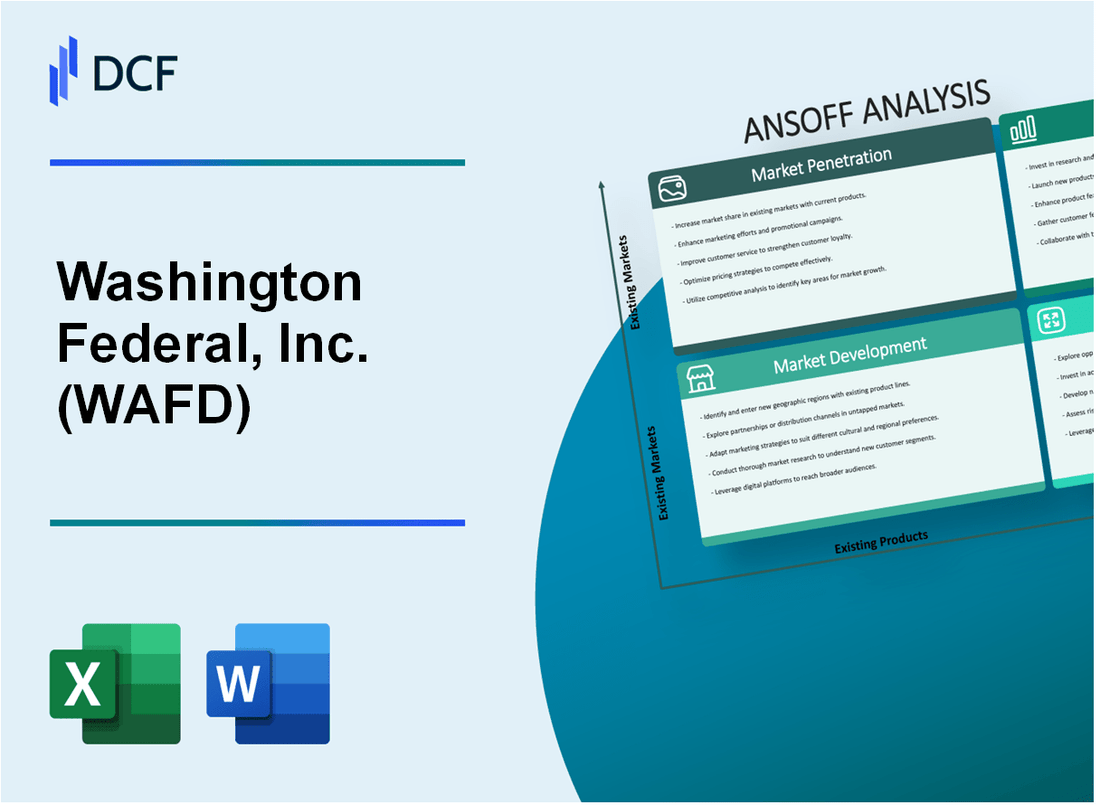
You're looking at Washington Federal, Inc.'s growth blueprint after their pivot to a commercial focus, and that's smart strategy. As someone who's mapped out bank strategies for years, I can tell you this Ansoff Matrix lays out clear paths-from the safer bets like boosting Commercial Real Estate loan volume by 5% in core markets or driving digital user engagement up 10%, to more aggressive plays like entering Denver or even launching a proprietary FinTech platform. We need to see exactly where the bank is placing its chips to drive returns now that they are leaning heavily into commercial lending, so let's dive into the actionable steps mapped across penetration, development, product innovation, and diversification.
Washington Federal, Inc. (WAFD) - Ansoff Matrix: Market Penetration
Market Penetration for Washington Federal, Inc. focuses on deepening relationships within its existing footprint and client base, building on the strategic shift to business banking that defined fiscal 2025.
To increase Commercial Real Estate (CRE) loan volume by 5% in core markets like Seattle and Phoenix, you should note the recent production momentum. For the full fiscal year 2025, Washington Federal, Inc. achieved total loan originations of $4.0 billion, an increase from $3.6 billion in fiscal 2024. Commercial loans were a significant driver, accounting for 83% of all loan originations during fiscal 2025. This focus is expected to continue, with management guiding for an active loan portfolio growth of 8%-12% in fiscal 2026. The total loan portfolio stood at $20.1 billion as of September 30, 2025.
Launching a targeted campaign to convert existing deposit-only clients into full-service commercial borrowers aligns with the ongoing deposit mix optimization. As of September 30, 2025, customer deposits totaled $21.4 billion. Transaction accounts, a key indicator of primary banking relationships, increased by 4.1% during the period, reaching 57.4% of total deposits, up from 55.3% the prior year. Furthermore, core deposits represented 77.9% of total deposits at year-end 2025.
Offering relationship-based pricing discounts on treasury management services helps secure and retain these higher-value commercial relationships, directly impacting funding costs. The Net Interest Margin (NIM) improved to 2.71% in the fourth fiscal quarter of 2025, up from 2.62% a year ago, partly due to a decreasing cost of deposits. A related goal under the Build 2030 initiative is targeting 20% non-interest-bearing deposits by 2030; as of Q4 2025, these deposits were 12% of the total.
Enhancing digital banking features to boost active user engagement by 10% across the current footprint is supported by recent investment activity. Total non-interest expense increased by 2.6% sequentially in Q4 2025, driven by strategic investments in talent and technology. This digital transformation is showing results in production, as new loan originations saw a 103% increase over the third quarter of 2025. The efficiency ratio for Q4 2025 was 56.82%.
Aggressively cross-selling Small Business Administration (SBA) loans to existing commercial deposit holders is facilitated by recent operational achievements. Washington Federal Bank has been designated as a Preferred Lender with the U.S. Small Business Administration, which streamlines the process for originating SBA-guaranteed loans. This status supports the broader strategic shift toward business banking solutions.
Here is a snapshot of the financial context supporting these penetration efforts:
| Metric | FY 2025 (Year End) | Q4 2025 | Comparison Point |
| Net Income (Common Shareholders) | $211.4 million | $56.9 million | Up 13% YoY (FY) |
| Diluted EPS | $2.63 | $0.72 | Q4 up from $0.71 in Q4 2024 |
| Net Interest Margin (NIM) | N/A | 2.71% | Up from 2.69% in Q3 2025 |
| Total Loan Originations | $4.0 billion | N/A | 103% increase in new originations over Q3 |
| Total Loans Receivable | $20.1 billion | N/A | Decreased $188 million during the quarter |
| Transaction Accounts (% of Deposits) | 57.4% | N/A | Up from 55.3% in FY 2024 |
| WaFd Insurance Revenue | $19.5 million | $4.6 million | Up 12.5% YoY |
The focus on deepening existing relationships involves several key operational areas:
- Reorganizing frontline teams for business banking.
- Expanding treasury solutions offerings.
- Maintaining 208 branches across 9 western states.
- Achieving 169 consecutive quarterly cash dividends.
You're looking to maximize share of wallet from current clients, which is the safest growth vector. The recent success in loan production is a good sign; the loan pipeline has been building for three consecutive quarters heading into 2026. Finance: draft the projected impact of a 5% CRE loan volume increase on Q1 2026 Net Interest Income by next Tuesday.
Washington Federal, Inc. (WAFD) - Ansoff Matrix: Market Development
You're looking at how Washington Federal, Inc. (WAFD) pushes its current commercial banking focus into new territories or client groups. This is Market Development in action, a core part of their strategy after exiting the single-family mortgage business in January 2025. The goal is clear: grow the business by delivering credit and treasury solutions where they aren't fully established yet.
The foundation for this expansion is solid, based on the fiscal year 2025 results. As of September 30, 2025, the company held total assets of $26.7 billion, with net loans standing at $20.1 billion. Commercial loans are now the main engine, making up 59.5% of that net loan portfolio. This focus drove total loan originations for the full year to $4.0 billion, an increase from $3.6 billion in fiscal 2024. Honestly, commercial loans accounted for a massive 83% of all loan originations in fiscal 2025, showing where the development effort is aimed.
Here are the specific market development thrusts you should track:
- Entering new metro areas, like Denver, Colorado, by deploying a commercial lending team to capture market share.
- Leveraging the existing presence in California, established via the March 1, 2024, merger, to deepen commercial real estate (CRE) penetration.
- Targeting middle-market businesses in existing states where WAFD Bank hasn't fully penetrated the client segment yet.
- Gaining immediate access through acquisition, though no specific commercial loan portfolio purchase was announced for 2025.
- Rolling out the existing commercial deposit suite to businesses in states like New Mexico, where WAFD Bank already has a branch network.
The push into new client segments within existing markets shows immediate results. For instance, the company reported making 382 small business loans in the three months ending March 31, 2025-that's up from zero the prior quarter, a defintely aggressive start to that specific market expansion. This shift is also reflected in deposit mix, where checking accounts, key for business banking, grew from 33% to 35% of total deposits over the year.
To give you a quick snapshot of the financial scale supporting this market development:
| Metric | Amount (As of 9/30/2025) | Comparison/Context |
| Net Income (FY 2025) | $211.4 million | $2.63 per diluted share |
| Total Assets | $26.7 billion | Down from $28.1 billion at 9/30/2024, reflecting asset mix shift |
| Net Loans | $20.1 billion | Decreased $0.8 billion year-over-year |
| Total Loan Originations (FY 2025) | $4.0 billion | Up from $3.6 billion in FY 2024 |
| Efficiency Ratio (FY 2025) | 58.9% | Improved from 62.1% in fiscal 2024 |
The company operates 208 branches across 9 western states as of September 30, 2025, providing the physical footprint for this market development strategy. The annual earnings for fiscal year 2025 were $226.1 million, marking a 13% increase over the prior fiscal year. Finance: draft the 13-week cash view by Friday.
Washington Federal, Inc. (WAFD) - Ansoff Matrix: Product Development
You're looking to expand Washington Federal, Inc.'s offerings into new product spaces, building on the bank's aggressive pivot toward commercial banking. This is where we map out the tangible numbers supporting these new ventures.
Introduce a new suite of specialized construction financing products for multi-family and industrial projects. This directly supports the strategic shift where commercial loans already represented 83% of all loan originations during fiscal year 2025. That year, total annual loan originations hit $4.0 billion. You need to manage the associated credit risk, especially since non-performing assets (NPAs) climbed to $143 million, or 0.54% of total assets, as of September 30, 2025. These new, specialized products must be underwritten to maintain or improve upon the current loan yield of 5.38% on the loan portfolio as of September 30, 2025.
Develop a proprietary digital cash flow forecasting tool for commercial clients to integrate with existing accounts. This investment is part of a broader technology push, evidenced by the $107.0 million in total non-interest expense reported for the fourth fiscal quarter of 2025, which included strategic investments in technology. The goal here is clear: drive core deposit growth. The bank is targeting non-interest-bearing deposits to reach 20% of total deposits by 2030, but they stood at only 12% of total deposits at the end of the fourth quarter of 2025. A superior digital tool helps lock in those operating accounts.
Launch a high-yield, tiered Certificate of Deposit (CD) product specifically for corporate treasury management. This targets larger commercial operating balances to help achieve that 20% non-interest-bearing deposit goal, or at least attract higher-quality interest-bearing deposits. The net interest margin (NIM) for the fourth fiscal quarter of 2025 was 2.71%, up from 2.62% a year prior. Offering competitive, tiered CDs helps manage the cost of liabilities, which was a key driver in that margin improvement, as the cost of interest-bearing liabilities was 2.91% at period end September 30, 2025.
Create a dedicated Environmental, Social, and Governance (ESG) lending product line for sustainable business projects. This aligns with the bank's existing community focus. For context, the Washington Federal Foundation awarded grants totaling over $1.1 million for the fiscal year 2024, showing a baseline commitment to the social component. New ESG-focused commercial loans can be structured to appeal to clients prioritizing sustainability metrics, potentially commanding a slight pricing advantage or attracting high-quality borrowers.
Offer a defintely simplified foreign exchange (FX) service for commercial clients with international trade needs. This is a natural extension of the focus on commercial and industrial (C&I) lending, as these clients often have cross-border payment or hedging requirements. This service aims to deepen the relationship with the commercial segment, which saw annual loan originations of $4.0 billion in fiscal 2025 and now constitutes 59.5% of the $20.1 billion net loan portfolio.
Here's a quick look at the foundational metrics underpinning these product development decisions:
| Metric | Value (FY 2025 / Q4 2025) | Context |
|---|---|---|
| Net Income (FY 2025) | $211.4 million | Overall profitability supporting new investment |
| Commercial Loan Mix (Originations FY 2025) | 83% | The core business focus for new products |
| Non-Performing Assets (NPA) | $143 million (0.54% of assets) as of 9/30/2025 | Risk metric to monitor with new CRE products |
| Non-Interest Bearing Deposits (as of 9/30/2025) | 12% of total deposits | Gap to the 2030 target of 20% |
| Tangible Book Value Per Share (as of 9/30/2025) | $29.38 | Measure of shareholder equity strength |
The strategic context for these product launches requires keeping a close eye on efficiency and shareholder returns:
- Efficiency Ratio for Q4 2025 was 56.82%.
- Quarterly cash dividend paid in 2025 was $0.27 per share.
- Total Assets were approximately $26.7 billion as of June 30, 2025.
- The bank operates 208 branches across nine western states.
- Loan pipeline has been building for three consecutive quarters as of Q4 2025.
Finance: draft the projected ROI model for the digital cash flow tool by Friday.
Washington Federal, Inc. (WAFD) - Ansoff Matrix: Diversification
You're looking at Washington Federal, Inc. (WAFD) as it executes a major pivot away from its legacy single-family mortgage business toward commercial banking, so diversification outside that core-even within financial services-is the next logical step for growth beyond its current nine western states. The bank finished fiscal year 2025 with a net income available to common shareholders of $211.4 million, translating to $2.63 in diluted EPS, but its Net Interest Margin (NIM) in Q4 2025 was 2.71%, showing the pressure to find non-interest income streams. With total assets near $26.7 billion and a market capitalization of $2.47 billion, any new venture must be scalable.
The proposed diversification strategies target high-growth or high-fee areas, leveraging the bank's existing capital base and commercial focus.
Establish a non-bank subsidiary focused on wealth management and trust services for high-net-worth individuals in Texas.
This move targets the concentration of wealth in Texas, a state where Washington Federal, Inc. (WAFD) already has a presence. The addressable market for high-net-worth individuals (HNWIs) is substantial:
- The top 1% of Americans, defined as having a minimum net worth of $11.2 million, commanded a record $52 trillion in combined assets in Q2 2025.
- The Forbes | SHOOK Top Wealth-Management Teams High Net Worth list tracks teams with cumulative assets exceeding $387 billion.
- Globally, the wealth management industry is projected to generate $2.1 trillion in revenues in 2025.
The focus on HNWIs aligns with the trend where top teams emphasize private-market allocations and intergenerational planning, which are high-fee services.
Acquire a specialty finance company in the Midwest, entering equipment leasing outside the current footprint.
Acquiring a specialty equipment leasing firm in the Midwest provides geographic and product diversification, moving Washington Federal, Inc. (WAFD) into a sector showing resilience. The equipment finance sector is seeing activity despite broader economic softness:
| Metric | Value (2025 Data) |
|---|---|
| Projected Equipment & Software Investment Growth (Annualized Pace) | 4.7% |
| Projected U.S. GDP Growth (Initial Forecast) | 2.7% |
| Equipment Finance Credit Approval Ratio (April 2025) | 77.4% |
The fact that credit approval ratios are rising suggests lenders are finding creditworthy borrowers, a positive signal for an acquisition strategy. This contrasts with the bank's own loan origination mix, where commercial loans represented 83% of the $4.0 billion in originations for fiscal year 2025.
Develop a proprietary FinTech platform for B2B payments and sell it as a service to other regional banks.
This is a product diversification play, turning an internal capability into a revenue stream. The B2B payments platform space is expanding rapidly, offering a high-growth, technology-driven fee opportunity to supplement Washington Federal, Inc. (WAFD)'s core lending income, which made up 92.4% of its total revenue over the last five years.
- The global B2B Payments Platform Market size was valued at approximately $4.81 Billion in 2024.
- This market is projected to grow at a Compound Annual Growth Rate (CAGR) of roughly 14.38% between 2025 and 2034.
- The overall global B2B Payments Market size is estimated at $1.42 trillion in 2025.
Selling this as a service (SaaS) to other regional banks taps into the need for automation and efficient cross-border transactions, which is projected to grow at a 20.34% CAGR through 2030.
Launch a private equity fund focused on investing in commercial real estate development projects in the Southeast US.
This leverages Washington Federal, Inc. (WAFD)'s existing commercial real estate expertise, but geographically shifts the focus to the high-growth Southeast. The CRE transaction market showed strong recovery momentum in Q3 2025:
- Aggregate US CRE transaction volume in Q3 2025 totaled $150.6 billion, up 23.7% from Q2 2025.
- Global dry powder for commercial real estate exceeds $350 billion.
- Private equity real estate fundraising rebounded to $57.1 billion in Q1 2025.
For context on asset pricing, multifamily cap rates in key Southeast metros like Atlanta, Charlotte, and Raleigh ranged between 4.75% and 5.5% in 2025.
Enter the insurance brokerage business, targeting commercial clients in new states like Oklahoma.
Washington Federal, Inc. (WAFD) already generates $19.5 million in revenue from its existing insurance subsidiary in fiscal year 2025, so expanding this is a natural extension. Targeting commercial clients in new states like Oklahoma provides a direct path to new fee income. The Oklahoma Insurance Brokers & Agencies industry market size is estimated at $1.8 billion in 2025, supported by 7,571 businesses in that sector.
The overall US Insurance Brokerage Market size stood at $140.38 billion in 2025, with commercial clients (SMEs) accounting for 42.8% of the market share in 2024, indicating a large pool of potential commercial brokerage clients for Washington Federal, Inc. (WAFD) to pursue outside its current footprint.
Disclaimer
All information, articles, and product details provided on this website are for general informational and educational purposes only. We do not claim any ownership over, nor do we intend to infringe upon, any trademarks, copyrights, logos, brand names, or other intellectual property mentioned or depicted on this site. Such intellectual property remains the property of its respective owners, and any references here are made solely for identification or informational purposes, without implying any affiliation, endorsement, or partnership.
We make no representations or warranties, express or implied, regarding the accuracy, completeness, or suitability of any content or products presented. Nothing on this website should be construed as legal, tax, investment, financial, medical, or other professional advice. In addition, no part of this site—including articles or product references—constitutes a solicitation, recommendation, endorsement, advertisement, or offer to buy or sell any securities, franchises, or other financial instruments, particularly in jurisdictions where such activity would be unlawful.
All content is of a general nature and may not address the specific circumstances of any individual or entity. It is not a substitute for professional advice or services. Any actions you take based on the information provided here are strictly at your own risk. You accept full responsibility for any decisions or outcomes arising from your use of this website and agree to release us from any liability in connection with your use of, or reliance upon, the content or products found herein.