

|
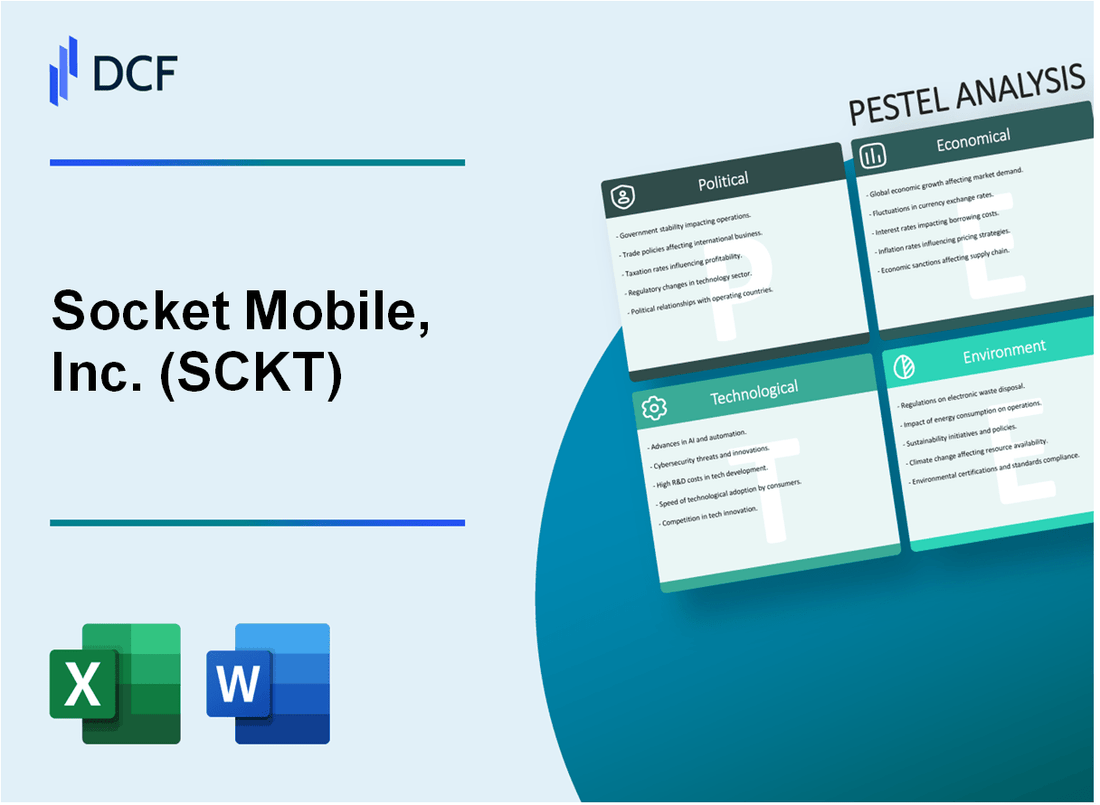
Socket Mobile, Inc. (SCKT): PESTLE Analysis [Nov-2025 Updated] |
Fully Editable: Tailor To Your Needs In Excel Or Sheets
Professional Design: Trusted, Industry-Standard Templates
Investor-Approved Valuation Models
MAC/PC Compatible, Fully Unlocked
No Expertise Is Needed; Easy To Follow
Socket Mobile, Inc. (SCKT) Bundle
You're looking for a clear, no-nonsense view of the external forces shaping Socket Mobile, Inc. (SCKT) right now. Honestly, the near-term risk is economic contraction hitting their customers' capital expenditure, but the long-term opportunity is a strategic pivot into the rugged industrial market. Here is the PESTLE analysis, grounded in their 2025 fiscal year reality, showing how a 20% Q3 2025 revenue decline to $3.1 million is being countered by a defintely necessary pivot toward the estimated $27 billion industrial handheld computing market.
Socket Mobile, Inc. (SCKT) - PESTLE Analysis: Political factors
You need to understand that political volatility, especially around trade, is a direct cost driver for Socket Mobile right now. The good news is a major regulatory win in Japan has opened a significant new government revenue channel. The near-term focus is managing tariff risk while aggressively pursuing the global digital ID opportunity.
Trade tariff dynamics complicate supply chain; 30% sourcing from Mexico, 20% from Taiwan.
The geopolitical landscape has made supply chain management a high-stakes political problem, not just a logistics one. Socket Mobile's reliance on key manufacturing hubs exposes it directly to shifting US trade policy, which management flagged as a source of uncertainty in Q1 2025. Here's the quick math on the exposure: roughly 30% of your sourcing comes from Mexico and another 20% from Taiwan.
The Taiwan exposure is the most immediate risk. In 2025, the US government announced a potential tariff increase on imports from Taiwan, which started at a high of 32% before being temporarily lowered to 10% for 90 days to allow for negotiations. This is a massive swing factor. For components like those used in your data-capture devices, even a sustained 10% tariff, let alone the potential for a return to the higher rate, compresses your gross margin, which was already down to 47.7% in Q3 2025. You simply cannot ignore a potential 10% to 32% cost hit on one-fifth of your component base.
The risk from Mexico is less severe but still present. While the US-Mexico-Canada Agreement (USMCA) provides some stability, the US paused the implementation of an additional 5% tariff on non-USMCA compliant goods in late 2025. This constant threat of new tariffs, even if temporarily averted, forces you to dedicate resources to strategic sourcing and pricing adjustments just to protect the margin.
Geopolitical tensions increase cost risks and slow distributor purchases.
Geopolitical tensions, particularly the uncertainty around US-China/Taiwan relations, have a chilling effect that extends beyond tariffs. Management noted that tariff dynamics have added supply chain complexity and that uncertainty has actually slowed distributor purchases and 'froze deployments' in Q1 2025. This cautious spending is a direct result of political risk translating into business risk, leading to lower-than-projected revenue of $4.0 million in Q1 2025.
The key risk here is the 'wait-and-see' approach from international distributors who fear being caught holding inventory that suddenly becomes subject to new, high import duties. This dynamic contributed to a year-over-year revenue decline of 20% in Q3 2025. The political noise is defintely costing you sales velocity right now.
| Supply Chain Political Risk Snapshot (2025) | Sourcing Exposure | Primary Political Risk | Quantified Tariff Risk |
|---|---|---|---|
| Mexico | ~30% | USMCA trade policy and potential for IEEPA tariffs | Additional 5% tariff implementation was paused in late 2025 |
| Taiwan | ~20% | US-Taiwan trade negotiations and Section 232 tariffs | Initial threat of 32%, lowered to 10% for 90 days on non-computer imports |
Approval as official My Number Card Reader Provider in Japan opens a specific government vertical.
On the flip side, a major political and regulatory win has created a clear path for growth. In August 2025, Socket Mobile's SocketScan S370 and S550 readers received official certification from the Japanese government as certified My Number Card readers. This is a significant political endorsement that immediately de-risks a new market entry.
This approval is a critical first step into a massive, government-backed digital identity market. The My Number Card system is Japan's national ID platform, with over 100 million cards issued, and it is the backbone for accessing services like tax, social security, and health insurance.
- Validates Technology: Official certification validates the performance and security of the S370 and S550.
- Opens Public Sector: Allows businesses and developers to integrate your readers into public-sector applications.
- Taps Digital ID Trend: Aligns with the card's recent integration into Apple Wallet on iOS, expanding the addressable market.
Government sector sales opportunity in digital ID, law enforcement, and airport security.
The Japan win is a perfect example of a broader, politically-driven opportunity: the global shift to digital identification (Digital ID) and Mobile Driver's Licenses (mDLs). Socket Mobile is strategically positioned to capitalize on this regulatory trend.
Governments worldwide are modernizing their ID infrastructure, driving demand for secure, mobile data capture solutions like yours. Your products are explicitly marketed for:
- Law Enforcement: Streamlining on-the-spot identity verification.
- Airport Security: Enhancing security and access control.
- Digital ID/mDL Rollouts: Supporting state-level initiatives, such as Illinois's launch of digital driver's licenses and IDs in 2025.
This government vertical represents a stable, high-security market segment that can offset the volatility of the retail and commercial sectors. The political push for digital identity is a multi-year tailwind, and being ISO 18013-5 compliant positions you well to capture this global public sector spending.
Socket Mobile, Inc. (SCKT) - PESTLE Analysis: Economic factors
The economic landscape for Socket Mobile, Inc. in late 2025 is defined by a clear contraction in customer spending, which is directly pressuring near-term revenue and liquidity. You need to understand that the core issue isn't a loss of end-user interest-sales-out to end-users remained stable-but rather a significant, cautious inventory reduction by distributors and a delay in large-scale enterprise deployments. This dynamic creates a tight cash position but also sets up a potential restocking opportunity for 2026, assuming the macro environment stabilizes.
Q3 2025 revenue declined 20% year-over-year to $3.1 million.
Socket Mobile's third-quarter performance for fiscal year 2025 shows the direct impact of a challenging economic environment. Revenue for Q3 2025 came in at just $3.1 million, marking a steep year-over-year decline of 20% from the $3.9 million reported in Q3 2024. This drop was largely a function of channel partners reducing their inventory and slowing new bookings, not a collapse in the final sale to the end-user. The gross margin also compressed slightly to 47.7% in Q3 2025, down from 49.0% in the prior year's quarter, mainly because fixed overhead costs were spread across a much lower volume of shipments.
Here's the quick math on the revenue trend:
| Metric | Q3 2025 | Q3 2024 | Change (YoY) |
|---|---|---|---|
| Total Revenue | $3.1 million | $3.9 million | -20% |
| Gross Margin | 47.7% | 49.0% | -1.3 percentage points |
| Operating Expenses | $2.5 million | $2.9 million | -13.8% |
| Operating Loss | $1.06 million | $1.03 million | +2.9% |
Management lowered 2H 2025 outlook to EBITDA neutral, down from a profitable expectation.
In response to the persistent revenue headwinds, management had to reset expectations for the second half of 2025. The initial hope for profitability was tempered, with the revised guidance anticipating Q4 2025 to be at best, earnings before interest, taxes, depreciation, and amortization (EBITDA) neutral. This is a significant shift, especially considering the Q3 2025 adjusted EBITDA loss was approximately $540,000. To be fair, the company has been defintely disciplined, cutting operating expenses to $2.5 million in Q3 2025, down from $2.9 million in the prior year, to help manage the cash burn.
The pivot to an EBITDA-neutral target for Q4 is a realistic action to manage investor expectations in a tough environment. It means the focus is now purely on cost control and surviving the current cycle, not on aggressive growth.
Customer cautious spending delays major deployment deals into 2026.
A key economic risk is the pervasive caution among enterprise customers. Major deployment deals-the kind that move the needle for a company of Socket Mobile's size-are being delayed. The CEO noted that customers are focused on cash preservation, pushing these large rollouts into the 2026 fiscal year. These delays are particularly impacting the newer, high-value industrial scanning products, even though the company has secured initial purchase orders (POs) from multiple Fortune 50 customers.
This macro-level caution translates into a deferred revenue stream, which is a near-term headwind but a potential long-term tailwind. The pipeline is there, but the execution timeline is stretched. This is a classic economic slowdown pattern.
- Slower distributor bookings and reduced channel inventory were the primary revenue drivers.
- Deployment deals were delayed as customers prioritize cash preservation.
- New industrial products are gaining traction, but the sales cycle is long.
- Management is positioning for stronger performance in 2026.
Cash balance is tight at approximately $2.0 million as of September 30, 2025.
Liquidity is the most immediate concern. The cash balance as of September 30, 2025, was approximately $2.0 million. This is down from $2.6 million at the end of Q2 2025, despite the company having raised $1.5 million in a secured subordinated convertible note financing in May 2025. The net cash used in operating activities for the first nine months of 2025 totaled approximately $1.6 million, highlighting the ongoing cash outflow challenge. This low cash balance is a critical constraint on operations, product development, and any aggressive marketing push. Achieving that EBITDA-neutral Q4 is crucial to avoid further dilutive financing rounds, as management has indicated no current plans for additional convertible debt, contingent on hitting that target.
Socket Mobile, Inc. (SCKT) - PESTLE Analysis: Social factors
You're looking at the social factors that shape Socket Mobile, Inc.'s (SCKT) addressable market, and the picture is clear: the post-pandemic labor environment is driving a fundamental shift toward mobile, efficient, and touchless workflows. This isn't just a convenience trend; it's a core operational necessity for businesses trying to manage a shrinking workforce and rising costs.
The key takeaway is that the social demand for productivity and seamless digital interaction is a powerful tailwind for Socket Mobile's core products, despite the company reporting softer demand in Q1 2025 with revenue at $4.0 million, reflecting cautious customer spending.
Growing demand for workforce mobilization solutions across retail, field service, and logistics.
The need to equip frontline workers with mobile tools-workforce mobilization (WM)-is no longer optional; it's a critical response to persistent labor challenges. Businesses in retail, field service, and logistics are scrambling to make their limited staff more effective. This is where Socket Mobile's data capture solutions, like their barcode scanners and contactless readers, fit right in.
The Field Service Management (FSM) market, a major component of WM, is projected to reach an estimated $5.1 billion in 2025 globally, growing at an 11% Compound Annual Growth Rate (CAGR). Specifically in the US, the FSM market is expected to total $3.6 billion with a CAGR of 10.9% through 2032. This growth is directly tied to the social pressure for faster service and better tracking of assets in the field. To be fair, this market growth is not immune to economic headwinds; Socket Mobile's management noted that deployment deals were delayed in Q3 2025, reflecting customers' cautious spending. Still, the underlying social and operational demand remains strong.
- Field service job postings surged 67% in 2025, signaling a hiring push.
- Delayed customer projects are expected to ramp up in Q2/Q3 2025, creating new service opportunities.
- The new XtremeScan products position the company to capture a share of the $27 billion mobile handheld computing market.
Increased adoption of Digital ID and contactless technology drives demand for NFC readers.
The global shift toward digital identity (Digital ID) and contactless transactions is a massive social trend that directly favors Socket Mobile's Near Field Communication (NFC) readers. Consumers now expect the ease of tap-and-go for everything, not just payments. This includes mobile driver's licenses (mDLs) for age verification, hotel check-ins, and loyalty programs.
In North America, the adoption is accelerating fast. As of September 2025, 48 digital ID schemes are tracked, covering approximately 69% of the adult population (around 177 million people). The US is catching up on contactless payments, too: 67% of consumers use contactless payments regularly in 2025, and 68% of all card transactions are contactless-enabled. The adoption of NFC technology in North America rose by a staggering 37.6% in 2025, driven by consumer demand for faster transactions. This means more businesses need NFC readers like the SocketScan S550 to keep up with consumer behavior.
| Social Trend Indicator (2025) | US/North America Data | Impact on Socket Mobile |
|---|---|---|
| Contactless Card Transactions (US) | 68% of all card transactions are contactless-enabled. | Directly increases demand for NFC readers/writers (e.g., SocketScan S550). |
| Digital ID Coverage (North America) | 69% of the adult population (177M people) covered by 48 schemes. | Creates a new, high-growth market for Digital ID-friendly scanners and readers. |
| NFC Technology Adoption (North America) | Increased by 37.6% in 2025. | Validates the strategic focus on NFC products for mobile wallets and IDs. |
| Global Contactless Payment Market Size | Global market projected to hit $69.7 billion in 2025. | Indicates a massive and defintely sustained global market opportunity. |
Focus on enhanced workplace productivity aligns with post-pandemic labor efficiency trends.
Post-pandemic, businesses are hyper-focused on labor efficiency. The social expectation for employees is to do more with less, which translates into a strong corporate appetite for tools that boost productivity. Socket Mobile's entire value proposition is centered on 'enhanced productivity in workforce mobilization.'
Their Q1 2025 product launch, the XtremeScan iXG and iXS Series, illustrates this focus. These devices are designed to serve as full-featured handheld computers, allowing frontline workers to capture data more accurately and perform critical tasks with greater speed. The logic is simple: if a device can shave seconds off a transaction or a data entry task, it saves thousands of labor hours across a large mobile workforce. This efficiency drive is a structural, long-term trend, not a cyclical one, and it is a key driver for the Field Service Management market.
Here's the quick math: a Fortune 50 industrial customer placed long-term rollout purchase orders for the new ruggedized scanning products, validating the product-market fit in environments where productivity gains are critical. This shows that despite Q1 2025 revenue being softer at $4.0 million, the long-term, high-value industrial market is still making strategic, productivity-focused investments. Finance: draft a sensitivity analysis on the impact of a 5% productivity gain for a Tier 1 logistics customer by Friday.
Socket Mobile, Inc. (SCKT) - PESTLE Analysis: Technological factors
Strategic pivot to the industrial handheld computing market (estimated at $27 billion)
Socket Mobile is making a defintely critical strategic pivot, moving beyond its traditional Bluetooth-connected scanner market to directly enter the mobile handheld computing space. This shift targets the full-featured industrial devices used in demanding environments like warehousing and logistics. The company itself estimates this total addressable market (TAM) at a substantial $27 billion, a figure that dwarfs the core barcode scanner market, which is valued at approximately $8.4 billion in 2025.
This expansion is a calculated move to capture a higher-value segment of the enterprise mobility spend. Here's the quick math: instead of selling a scanner accessory, Socket Mobile is now selling a complete, ruggedized data capture computer. This move allows them to compete directly with industry giants like Zebra Technologies and Honeywell, but with a unique focus on the widely adopted Apple iOS platform. You have to go where the big contracts are.
The core challenge here is that the Industrial Handheld Computer market is also projected to reach USD 15.8 billion by 2025 in some analyses, which is a significant opportunity, but also highlights the need for Socket Mobile to clearly differentiate its iOS-centric solution in a market traditionally dominated by proprietary operating systems.
Launched XtremeScan ruggedized products integrated with the iOS platform (e.g., iPhone 16e)
The XtremeScan and DuraSled product families are the physical embodiment of this strategic pivot, offering industrial-grade protection and high-performance scanning integrated with Apple's latest devices. The XtremeScan iXG and iXS Series, for instance, are designed as fully integrated handheld computers, featuring the new, durable iPhone 16e and running on iOS 18.3.
These products provide the rugged durability needed in demanding sectors like manufacturing and logistics, protecting the consumer-grade iPhone from water, dust, and drops. The XtremeScan Mag series, including the XS640, XS630, and XG630, offers various scanning options-from 1D laser to 1D/2D imagers-with Manufacturer's Suggested Retail Prices (MSRPs) ranging from $699 to $899 per unit. This pricing positions them as a premium, yet potentially more flexible, alternative to traditional rugged devices.
The initial traction is encouraging; the company reported that XtremeScan scanners are gaining momentum, even as Q2 2025 revenue declined to $4.04 million due to broader market softness.
| XtremeScan Mag Product | Scanning Capability | MSRP (Approx.) | Target Use Case |
|---|---|---|---|
| XS640 | Fast 1D/2D Barcode Scanning | $799 | High-volume 1D/2D applications |
| XS630 | Precise 1D Laser Scanning | $699 | Damaged or worn 1D barcodes |
| XG630 | Precise 1D Laser Scanning | $899 | Long-range 1D scanning in industrial settings |
Introduced CaptureSDK 2.0 to simplify integration for thousands of developer partners
The software foundation supporting this hardware push is the newly launched CaptureSDK 2.0, released in October 2025. This Software Development Kit (SDK) is a major technological upgrade, designed to simplify the integration process for their global developer community. The key benefit is a unified platform that allows application providers to upgrade once and automatically support both existing and all upcoming devices, including the new Bluetooth Low Energy (LE)-based scanners.
This simplified integration is crucial because it ensures continuity for the hundreds of thousands of end users who depend on Socket Mobile scanners daily across platforms like Square and Shopify. The new SDK also enables the rollout of more affordable hardware, like the new SocketScan S721 1D/2D scanner, which is scheduled for a Q4 2025 release at a retail price of just $199.
The SDK's strength is its ability to future-proof the application ecosystem. Key technological advantages of CaptureSDK 2.0 include:
- Transition to Bluetooth LE for extended battery life.
- Faster connections and quicker application integration.
- Single integration point for all Socket Mobile devices (scanners and NFC readers).
- 100% compatibility maintained for existing devices.
Competition from lower-cost, camera-based scanning solutions (like their own SocketCam C820)
A significant technological headwind is the increasing adoption of camera-based scanning, which leverages the powerful cameras already built into modern smartphones. This technology is emerging rapidly in the broader barcode scanner market. Socket Mobile addresses this competition by including its own software solution, SocketCam C820, directly within the CaptureSDK.
SocketCam C820 is a free, integrated camera scanner that uses the exact same Application Programming Interface (API) as the physical scanners. This is a smart defensive move, as it allows developers to build and test their apps without buying a physical scanner, creating a frictionless path to upgrade later. The risk, however, is that for many low-volume retail or light-industrial use cases, the free camera-based solution may be 'good enough,' cannibalizing sales of the company's lower-end physical scanners.
The overall barcode scanner market, valued at USD 8.4 billion in 2025, is seeing a trend toward mobile scanning solutions, which accounts for about 70.0% of the market. This trend validates Socket Mobile's mobile-first strategy, but the competition is fierce, with major players like Zebra, Honeywell, and Datalogic all vying for market share with their own hardware and software solutions.
Socket Mobile, Inc. (SCKT) - PESTLE Analysis: Legal factors
Compliance with complex data privacy laws (like GDPR or CCPA) is critical for Digital ID solutions.
You are operating in a market where your data capture solutions, especially those for Digital ID, sit right at the intersection of commerce and personal privacy. This means you defintely face a high and fragmented compliance burden. Your devices handle data that, once processed by a client's application, falls under strict regulations like the European Union's GDPR (General Data Protection Regulation) and the patchwork of US state laws, notably the CCPA/CPRA (California Consumer Privacy Act/California Privacy Rights Act). Socket Mobile, Inc.'s own policy acknowledges the need to comply with GDPR, defining its role as a potential Data Controller in certain contexts.
The risk here is financial and reputational. For example, laws like the Virginia Consumer Data Protection Act (VCDPA) allow for fines up to $7,500 per violation for non-compliance, which can scale quickly for a B2B provider whose technology is used across thousands of customer systems. The company must ensure its CaptureSDK and hardware architecture enable customers to meet mandates like the right to data portability and the right to erasure (the right to be forgotten) without excessive development effort.
Here's the quick math: a single, large-scale data breach impacting a key customer could result in millions in indirect liability and direct compliance costs, far overshadowing the Q2 2025 operating loss of $0.68 million.
Product compliance with specific national standards is required for government contracts (e.g., Japan's My Number Card).
Securing high-value government contracts hinges entirely on meeting specific, non-negotiable national technical and security standards. This is a clear opportunity, but it requires significant, proactive investment in certification. A prime example is the Japanese government's national ID system, the My Number Card program, which has already issued over 100 million cards.
Socket Mobile, Inc. successfully navigated this hurdle in August 2025, when its SocketScan S370 and S550 readers received official certification as My Number Card readers. This approval is a legal gateway to public-sector and commercial applications in one of the world's most advanced digital economies. The certification process itself validates the devices' adherence to strict security and data-handling protocols, which is a major competitive advantage.
Furthermore, the company's products support the international standard ISO 18013-5 for Mobile Driver's Licenses (mDLs), positioning them for future government and commercial digital ID rollouts in the US and globally. This is a smart move to capture the next wave of government digitization.
| Key Government Compliance Standard | Socket Mobile Product Status (2025) | Market Scale/Impact |
|---|---|---|
| Japan My Number Card Certification | SocketScan S370 and S550 officially certified (August 2025). | Over 100 million cards issued; opens door to public and commercial sectors in Japan. |
| ISO 18013-5 (Mobile Driver's Licenses) | Devices support the standard. | Standard being adopted by US states (e.g., New York, West Virginia) and international jurisdictions for mDLs. |
Products must meet commercial inspection and audit standards for B2B customers.
In the B2B space-think manufacturing, logistics, and commercial facility management-your customers need to know your data capture tools won't introduce risk into their own legally mandated processes. This is why commercial inspection and audit standards are a critical legal factor, even if they aren't direct government mandates. Socket Mobile, Inc. addresses this by positioning its readers for use in commercial inspections and quality control, where real-time, accurate data capture is essential for compliance with safety codes.
The core legal and quality assurance standard here is the company's ISO 9001 certification. This is an internationally recognized standard for quality management systems, which means a third-party firm audits the company's processes for adherence to quality principles.
This certification is essentially a pre-qualification for large enterprise customers, particularly those in regulated industries like food handling or oil & gas, who have their own rigorous audit requirements. It provides the necessary assurance that the hardware and its supporting processes are reliable, which is a non-negotiable requirement for systems used in:
- Verifying compliance with safety regulations during facility audits.
- Maintaining product consistency and reducing waste in manufacturing.
- Controlling access to sensitive areas using digital ID credentials.
This commitment to quality helps to reduce the legal risk of product liability claims stemming from hardware failure or inaccurate data capture in mission-critical environments.
Socket Mobile, Inc. (SCKT) - PESTLE Analysis: Environmental factors
The company currently does not report specific carbon emissions data.
You need to be clear-eyed about the data gaps in your environmental strategy, and for Socket Mobile, Inc., the biggest gap is primary emissions reporting. As of the 2025 fiscal year, the company currently does not report specific carbon emissions data, including Scope 1, Scope 2, or the critical Scope 3 (value chain) emissions.
This lack of transparency makes it defintely challenging for investors and customers to benchmark the company's absolute carbon footprint against peers like Texas Instruments or Universal Electronics, Inc., who do report these figures. For a small-cap hardware company, this is not uncommon, but it creates a material risk as regulatory pressure, particularly from the Securities and Exchange Commission (SEC) on climate disclosure, continues to mount.
DitchCarbon score of 23 is below the industry average of 32, indicating a lag in climate action reporting.
The company's DitchCarbon score, which assesses a firm's carbon action and commitment to emissions reduction, sits at a low 23. This is a clear signal of underperformance when you compare it to the industry average of 32 for the Electrical Machinery Manufacturing sector. Here's the quick math: a score of 23 means Socket Mobile is lagging behind the median peer in terms of setting public targets, providing clear transparency, and demonstrating measurable progress toward decarbonization.
This score doesn't necessarily mean the company is doing nothing, but it confirms their public reporting is insufficient to meet modern environmental, social, and governance (ESG) standards. The low score is a direct consequence of the non-reporting of carbon emissions data and the absence of publicly committed 2030 or 2050 climate goals.
Focus on DuraScan and ruggedized products supports a longer product life cycle, reducing e-waste frequency.
The company's most tangible environmental opportunity lies in its product design philosophy, specifically with the DuraScan and other ruggedized product lines. These products are engineered for durability, which directly supports a longer product life cycle and therefore reduces the frequency of electronic waste (e-waste) generation. A longer product life is the simplest way to cut down on environmental impact.
Socket Mobile also backs this up with a comprehensive circular economy strategy to manage end-of-life products.
- Recycling/Trade-In Program: Allows customers to recycle old units or trade them in for a discount on new readers.
- Refurbishment: Old units are repaired and resold through the Recycling Products Program, extending their useful life.
- Packaging: Uses 100% recyclable, uncolored shipping boxes, free from harmful dyeing chemicals.
- Component Reduction: Removed USB charging adapters from products, acknowledging most businesses already have them, which cuts down on accessory e-waste.
This focus on product longevity and end-of-life management is a strong operational counterpoint to the weak public climate disclosure.
| Environmental Metric (2025) | Socket Mobile, Inc. (SCKT) Value | Industry Context | Strategic Implication |
|---|---|---|---|
| Carbon Emissions Disclosure (Scope 1, 2, 3) | Not reported for FY2025 | Peer companies report Scope 1, 2, and 3 emissions | High regulatory risk; impedes investor ESG analysis. |
| DitchCarbon Score (Climate Action) | 23 | Industry Average: 32 (Electrical Machinery Mfg.) | Indicates a lag in public climate action reporting and target setting. |
| Product Life Cycle Strategy | DuraScan ruggedized products (IP54-rated) | Directly addresses the growing global e-waste problem. | Strong operational defense against e-waste; a key competitive advantage. |
| E-Waste Management Program | Comprehensive recycling and trade-in program | Compliance with WEEE and RoHS Directives | Mitigates legal risk in European markets and supports circular economy goals. |
Finance: Budget for a third-party Scope 3 emissions assessment by Q2 2026 to address the DitchCarbon score and prepare for future SEC mandates.
Disclaimer
All information, articles, and product details provided on this website are for general informational and educational purposes only. We do not claim any ownership over, nor do we intend to infringe upon, any trademarks, copyrights, logos, brand names, or other intellectual property mentioned or depicted on this site. Such intellectual property remains the property of its respective owners, and any references here are made solely for identification or informational purposes, without implying any affiliation, endorsement, or partnership.
We make no representations or warranties, express or implied, regarding the accuracy, completeness, or suitability of any content or products presented. Nothing on this website should be construed as legal, tax, investment, financial, medical, or other professional advice. In addition, no part of this site—including articles or product references—constitutes a solicitation, recommendation, endorsement, advertisement, or offer to buy or sell any securities, franchises, or other financial instruments, particularly in jurisdictions where such activity would be unlawful.
All content is of a general nature and may not address the specific circumstances of any individual or entity. It is not a substitute for professional advice or services. Any actions you take based on the information provided here are strictly at your own risk. You accept full responsibility for any decisions or outcomes arising from your use of this website and agree to release us from any liability in connection with your use of, or reliance upon, the content or products found herein.