

|
Socket Mobile, Inc. (SCKT): 5 FORCES Analysis [Nov-2025 Updated] |
Fully Editable: Tailor To Your Needs In Excel Or Sheets
Professional Design: Trusted, Industry-Standard Templates
Investor-Approved Valuation Models
MAC/PC Compatible, Fully Unlocked
No Expertise Is Needed; Easy To Follow
Socket Mobile, Inc. (SCKT) Bundle
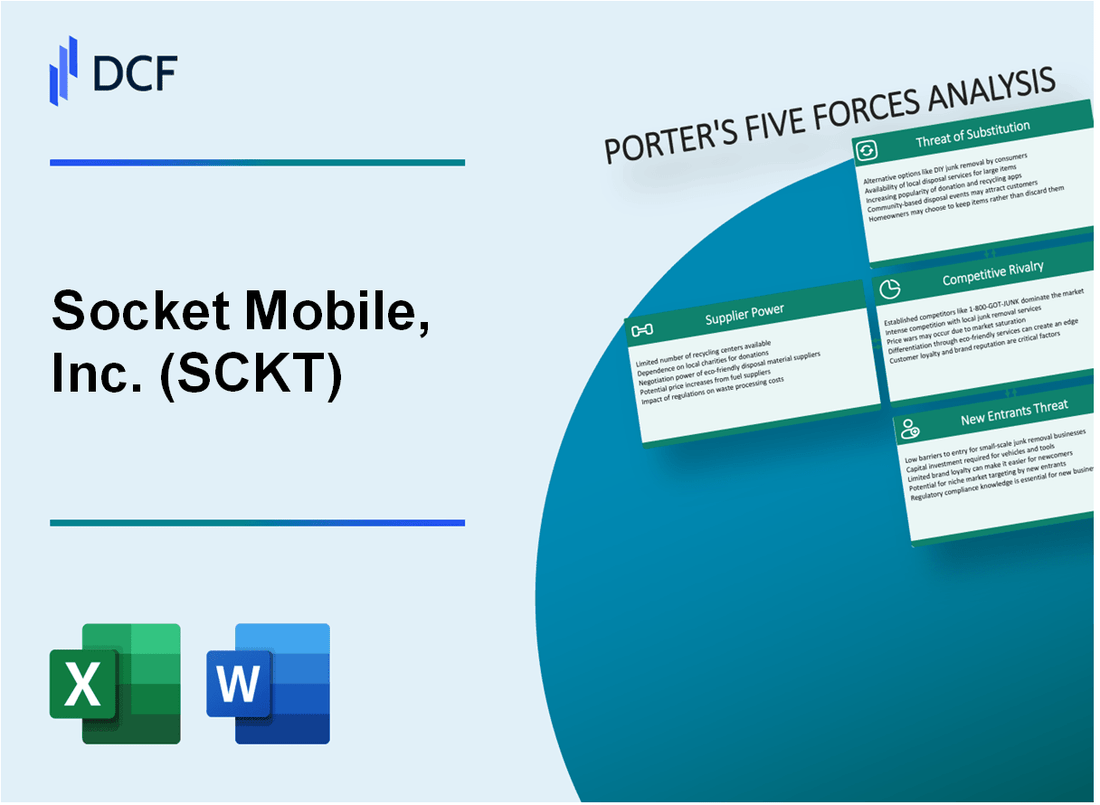
You're looking at a small player, Socket Mobile, Inc. (SCKT), in a tough spot as we hit late 2025. Honestly, when you see Q3 revenue drop 20% year-over-year to just $3.1 million, and the whole company valued around $10 million, you know the pressure is on. Facing giants like Zebra Technologies and Honeywell International, their small size defintely amplifies every classic industry threat. To get a clear, unvarnished view of exactly where the leverage lies-from suppliers squeezing component costs to customers easily switching-we need to break down their market position using Michael Porter's Five Forces framework. Dive in below to see the hard numbers behind the risk map.
Socket Mobile, Inc. (SCKT) - Porter's Five Forces: Bargaining power of suppliers
For Socket Mobile, Inc., the bargaining power of its suppliers, particularly those providing core electronic components like semiconductors, remains a significant factor shaping its cost structure and operational flexibility. You see this pressure reflected directly in the company's recent financial performance.
The reliance on a few electronic component suppliers for core hardware is a structural vulnerability. While Socket Mobile, Inc. operates in the $27 billion mobile handheld computing market, its scale is dwarfed by the major technology firms that dictate terms in the semiconductor ecosystem. This disparity in procurement volume inherently reduces Socket Mobile, Inc.'s leverage when negotiating pricing or securing priority allocation during tight supply periods.
The global semiconductor supply chain turbulence, though easing from its peak, continues to create component cost volatility in 2025. Lingering bottlenecks, especially for advanced packaging and specialized chips, mean that even for a company like Socket Mobile, Inc., securing necessary parts is not guaranteed at favorable rates. This environment forces the company to be highly strategic about its sourcing.
Here's a quick look at the revenue scale difference, which helps illustrate the leverage imbalance with major component vendors:
| Company Name | Latest Reported Revenue (Approximate) | Context |
|---|---|---|
| Socket Mobile, Inc. (SCKT) | $15.95 million (TTM ending Sep 30, 2025) | Small-scale specialty provider |
| Taiwan Semiconductor Manufacturing Company | $119.13 billion | Major global foundry |
| Apple | $416.16 billion | Massive volume buyer |
The impact of supply chain dynamics and external policies is visible in the gross margin figures. For instance, in the third quarter of 2025, Socket Mobile, Inc.'s gross margin compressed to 47.7%, down from 51% in the preceding quarter. Management noted this compression reflected the impact of fixed overhead costs being spread across a lower revenue base, a direct consequence of lower volumes.
Furthermore, geopolitical and tariff landscapes directly impact the Cost of Goods Sold (COGS). Socket Mobile, Inc.'s President and CEO specifically noted in April 2025 that the company was closely monitoring the evolving tariff landscape and assessing its potential impact on the supply chain and cost structure. In fact, tariff uncertainty was cited as a factor that curtailed distributor purchases in Q3 2025, signaling persistent headwinds through the year.
The supplier power is amplified by these external factors, leading to tangible financial pressure:
- Revenue for Q3 2025 was $3.1 million, a 20% decrease year-over-year.
- The gross margin fell to 47.7% in Q3 2025 from 50.4% in Q1 2025.
- Cash balances were approximately $2.0 million as of September 30, 2025, down from $2.5 million at the end of 2024.
- The industry context shows that despite efforts like the US CHIPS Act offering over $33 billion in grants, demand for advanced components is expected to outpace domestic supply, meaning reliance on global sources remains high.
Socket Mobile, Inc. (SCKT) - Porter's Five Forces: Bargaining power of customers
You're looking at the customer side of the equation for Socket Mobile, Inc. (SCKT) as of late 2025, and frankly, the power dynamic leans heavily toward the buyers right now. This isn't just a feeling; the numbers from the third quarter of 2025 tell a clear story about who holds the leverage.
Power is high as revenue is driven by gross shipments to major distributors. Think about it: Socket Mobile, Inc.'s Q3 2025 revenue came in at just $3.1 million, a 20% drop year-over-year. When your top line is so dependent on a few channel partners, their negotiating position strengthens considerably. We see this concentration clearly in the receivables:
| Distributor | Q3 2025 Revenue Share | Q3 2025 Receivables Share |
|---|---|---|
| BlueStar, Inc. | 31% | 36% |
| ScanSource, Inc. | 14% | 26% |
That concentration means if one of these key players decides to squeeze terms or shift volume, the impact on Socket Mobile, Inc.'s financials-like the Q3 gross margin of 47.7%-is immediate and material. Honestly, when your operating expenses are $2.5 million against only $3.1 million in revenue, you can't afford to lose leverage with your biggest customers.
Distributors are reducing channel inventory due to cautious customer spending. This is the core issue we saw play out in Q3 2025. Management noted that slower distributor bookings and reduced channel inventory materially lowered reported revenue, even though sales-out to end-users remained stable compared to Q2. This suggests distributors are running lean, which means they are less incentivized to place large, forward-looking orders with Socket Mobile, Inc. until they see clearer demand signals.
End-users face low switching costs between competing data capture hardware brands. While we don't have a specific dollar figure for the cost to switch a warehouse worker from one scanner brand to another, the reality in this market is that if a competitor offers a comparable device that integrates more easily or has a better immediate price point, the friction to change is low. Socket Mobile, Inc. is pushing its new CaptureSDK 2.0 to ease partner upgrades, which hints at the ongoing need to reduce adoption hurdles for end-users, a clear sign that inertia isn't enough to keep customers locked in.
Delayed deployment deals reflect customers' focus on cash preservation in late 2025. This is the macro environment hitting the order book directly. The company explicitly stated that several deployment deals were delayed, which management tied to customers' cautious spending and their continued focus on cash preservation. When you look at the cash balance ending Q3 2025 at approximately $2.0 million, you understand why management is so focused on expense control; the customers' need to preserve cash directly translates into delayed revenue recognition for Socket Mobile, Inc.
- Delayed large industrial rollouts extend timelines to monetization.
- Customers prioritize cash preservation over immediate capital expenditure.
- Distributors are managing down their stock levels aggressively.
- End-user hardware refresh cycles are being postponed.
Finance: draft 13-week cash view by Friday.
Socket Mobile, Inc. (SCKT) - Porter's Five Forces: Competitive rivalry
You're looking at Socket Mobile, Inc. (SCKT) in a market dominated by behemoths. The competitive rivalry here is, frankly, intense. It's not just a few players; it's a fight against giants like Zebra Technologies and Honeywell International in the data capture space. These large firms have massive R&D budgets and established enterprise sales channels, which puts immense pressure on a smaller entity like Socket Mobile, Inc.
This scale difference is starkly visible in the financials. As of November 2025, Socket Mobile, Inc.'s market capitalization hovers around $10.052 million. Honestly, that small valuation makes the company acutely vulnerable to aggressive pricing moves from competitors who can absorb margin compression for much longer periods. When you're valued this low, every pricing decision by a larger rival feels like a direct threat to your survival.
The financial results from the third quarter of 2025 clearly reflect this market strain. Socket Mobile, Inc. reported revenue of $3.1 million for Q3 2025. That number represents a 20% decrease compared to the $3.9 million in revenue from the prior year's quarter. When revenue is contracting this sharply, it signals that market share is being lost or the overall market demand Socket Mobile, Inc. serves is softening significantly under competitive duress.
Here's a quick look at how the Q3 2025 performance stacks up against the prior year, showing where the pressure is biting:
| Metric | Q3 2025 Actual | Q3 2024 Actual | Change (YoY) |
|---|---|---|---|
| Revenue | $3.1 million | $3.87 million | -20% |
| Gross Margin | 47.7% | 49.0% | -1.3 percentage points |
| Operating Expenses | $2.5 million | $2.9 million | -13.8% |
| Operating Loss | $1.06 million | $1.03 million | Increase in Loss |
To fight back against this rivalry, Socket Mobile, Inc. must lean hard on differentiation. Their primary defense mechanism seems tied to deep integration within the Apple ecosystem. You see this commitment in their software offerings, specifically the CaptureSDK 2.0 launch, which is foundational for next-generation Bluetooth LE hardware and ensures backward compatibility.
The strategy hinges on making their hardware the seamless choice for iOS-based mobile workforces. This focus creates a stickiness that generalist scanners might lack. Still, the company's near-term reality is one of tight liquidity, with the cash balance at approximately $2.0 million as of September 30, 2025. This low cash position means they can't afford a prolonged price war.
The key areas where Socket Mobile, Inc. is trying to carve out defensible space include:
- Focus on iOS ecosystem integration for seamless pairing.
- New platform software, CaptureSDK 2.0, for improved speed and battery life.
- Gaining traction in industrial scanning with initial Purchase Orders from multiple Fortune 50 customers.
- Diversifying beyond retail into logistics, manufacturing, mining, and energy sectors.
The success of these long-cycle industrial rollouts will be critical to offsetting the pressure from established competitors in the core markets. Finance: draft 13-week cash view by Friday.
Socket Mobile, Inc. (SCKT) - Porter's Five Forces: Threat of substitutes
You're looking at the competitive landscape for Socket Mobile, Inc. (SCKT) and the substitutes are definitely a major factor to consider. The threat here isn't just from other dedicated hardware makers; it's from the very devices your customers already carry.
High threat from software-only scanning applications utilizing standard smartphone cameras.
This is the most immediate pressure point. Modern smartphones, powered by on-device Artificial Intelligence (AI), have become surprisingly capable scanners. The global On-Device AI Market itself is estimated to be valued at $26.61 billion in 2025, with the smartphones segment holding an estimated share of 46.2% in 2025. This massive installed base of capable devices means many basic scanning needs can be met without purchasing dedicated hardware. For Socket Mobile, Inc., this dynamic is reflected in their recent financial performance; their revenue for the third quarter ending September 30, 2025, was $3.1 million, a decrease from prior periods, suggesting softer demand in their traditional markets. Still, this threat is most potent for low-volume, basic tasks.
Consumer-grade mobile devices increasingly replace dedicated scanners for basic tasks.
The market for pure software solutions is substantial. The Scanner Software Market, which covers the tools that make these smartphone cameras effective, is valued at $6.7 billion in 2025. This shows the sheer scale of the digital imaging ecosystem that doesn't rely on specialized hardware like Socket Mobile, Inc.'s products. To be fair, dedicated scanners still win on speed and reliability in high-throughput environments, but for many everyday uses, the smartphone is 'good enough.'
The new XtremeScan line, priced at up to $1,947, competes with lower-cost general-purpose readers.
Socket Mobile, Inc. is fighting back by targeting the high-end industrial segment where smartphone cameras fail. They began shipping their new XtremeScan products in the first quarter of 2025, aiming for the industrial barcode market. This line includes the XtremeScan iXG963 model, which is listed with a price point of up to $1,947. This positions their premium offering against other general-purpose readers, but it also means they are competing against lower-cost, non-integrated readers that might start around the $799.00 mark for industrial models from competitors. The company's trailing twelve months (TTM) revenue as of November 2025 was $15.94 Million USD, showing the scale of the market they need to capture against these substitutes.
The market shift to 2D barcodes is easily addressed by non-Socket Mobile products.
The industry is moving toward 2D symbologies, which Socket Mobile, Inc. supports, but so does everyone else. The global 2D Barcode Reader Market is projected to reach $9.3 billion in 2025. Competitors like Cognex Corporation and Keyence are launching AI-driven 2D readers, meaning the technology itself is not a moat. This means Socket Mobile, Inc. must compete on integration, durability, and ecosystem, not just on the ability to read a QR code. The ease with which non-Socket Mobile products address the 2D shift means the threat of substitution is high across the board, forcing Socket Mobile, Inc. to focus on niche, ruggedized, and iOS-integrated solutions.
| Market/Metric | Value (as of late 2025) | Relevance to Substitutes |
|---|---|---|
| On-Device AI Market Size | $26.61 billion | Indicates the scale of the platform (smartphones) running substitute software. |
| Scanner Software Market Size | $6.7 billion | Represents the market for non-hardware scanning solutions. |
| 2D Barcode Reader Market Size | $9.3 billion | The market Socket Mobile, Inc. is in, which is also served by non-dedicated solutions. |
| XtremeScan iXG963 Price Point | $1,947 | The high-end price Socket Mobile, Inc. is charging for its specialized solution. |
| SCKT Q3 2025 Revenue | $3.1 million | Reflects current sales volume amidst substitution pressure. |
- Smartphones handle basic scanning via on-device AI.
- Scanner software market is valued at $6.7 billion in 2025.
- Industrial XtremeScan iXG963 lists for $1,947.
- 2D reader market is $9.3 billion in 2025.
- SCKT TTM Revenue is $15.94 Million USD.
Finance: draft 13-week cash view by Friday.
Socket Mobile, Inc. (SCKT) - Porter's Five Forces: Threat of new entrants
You're looking at the barriers to entry for Socket Mobile, Inc. (SCKT) in late 2025, and honestly, it's a mixed bag. The threat isn't uniform; it splits right down the middle between hardware and software.
Medium barrier due to the required investment in ruggedized hardware R&D and manufacturing.
Building the physical scanners, especially the new ruggedized line like the XtremeScan Series designed for industrial use, requires serious capital commitment. You can see this pressure in Socket Mobile, Inc.'s own financial discipline. For the third quarter of 2025, the company reported revenue of just $3.1 million, yet R&D expenses for that same quarter were $1.03 million. That's a significant portion of top-line revenue dedicated to future product development, which sets a high bar for a newcomer needing to fund both initial production runs and the necessary research into areas like Bluetooth LE integration and industrial durability.
Here's a quick look at how the investment in innovation compares to the current sales reality for Socket Mobile, Inc. as of Q3 2025:
| Metric | Q3 2025 Amount | YTD 2025 Amount |
|---|---|---|
| Revenue | $3.1 million | $11.12 million |
| R&D Expenses | $1.03 million | $3.26 million |
| R&D as % of Revenue | 33.2% | 29.3% |
What this estimate hides is the sunk cost in tooling and certifications required for hardware manufacturing, which is a major hurdle for any new entrant trying to compete on physical product quality.
Low barrier for software-focused entrants leveraging mobile device APIs for data capture.
On the other side, if a new competitor focuses purely on the software layer-the application that uses the scanner-the barrier drops considerably. New players don't need to invest the millions Socket Mobile, Inc. does in hardware R&D; they just need to write code that talks to the device. They can start by integrating with native mobile device APIs or by building a simple wrapper around existing Bluetooth protocols. This is definitely where the market feels the most pressure, as software development costs are lower and iteration speed is much faster.
CaptureSDK 2.0 creates a developer ecosystem moat, but this can be replicated.
Socket Mobile, Inc. recently launched CaptureSDK 2.0 on October 8, 2025, which is their attempt to lock in developers by ensuring seamless transition to new Bluetooth LE devices while maintaining compatibility with the existing installed base. The company notes this platform supports hundreds of thousands of end users relying on their scanners daily across platforms like Shopify and Square. That installed base and the unified platform create a moat, but it's not impenetrable. A well-funded competitor could offer a superior, easier-to-integrate SDK with better performance metrics, effectively convincing developers to migrate their applications over time. It's a strong defense, but one that requires constant, costly updates to maintain.
New entrants can easily target the $27 billion mobile handheld computing market with novel solutions.
The sheer size of the addressable market is a huge magnet for new entrants. Socket Mobile, Inc. itself stated that its new XtremeScan products formally entered the $27 billion iOS-powered industrial handheld computing market in Q1 2025. That massive dollar figure signals ample room for new players to carve out a niche, especially with novel solutions that might better integrate on-device AI or offer a different form factor than Socket Mobile, Inc.'s traditional scanner attachments. The general global mobile computer market was projected to reach $6.77 billion in 2025, but the specific segment Socket Mobile, Inc. is pushing into is clearly much larger, attracting attention.
Here are some key factors influencing the ease of entry for these potential competitors:
- New entrants can target specific verticals like logistics or warehousing first.
- Software-only entrants avoid the high capital expenditure of hardware.
- The move to Bluetooth LE standardizes connectivity, lowering integration friction.
- Socket Mobile, Inc.'s Q3 2025 cash balance was only about $2.0 million, suggesting limited resources for a protracted competitive fight.
Finance: draft a sensitivity analysis on R&D spend vs. Q4 2025 revenue projection by next Tuesday.
Disclaimer
All information, articles, and product details provided on this website are for general informational and educational purposes only. We do not claim any ownership over, nor do we intend to infringe upon, any trademarks, copyrights, logos, brand names, or other intellectual property mentioned or depicted on this site. Such intellectual property remains the property of its respective owners, and any references here are made solely for identification or informational purposes, without implying any affiliation, endorsement, or partnership.
We make no representations or warranties, express or implied, regarding the accuracy, completeness, or suitability of any content or products presented. Nothing on this website should be construed as legal, tax, investment, financial, medical, or other professional advice. In addition, no part of this site—including articles or product references—constitutes a solicitation, recommendation, endorsement, advertisement, or offer to buy or sell any securities, franchises, or other financial instruments, particularly in jurisdictions where such activity would be unlawful.
All content is of a general nature and may not address the specific circumstances of any individual or entity. It is not a substitute for professional advice or services. Any actions you take based on the information provided here are strictly at your own risk. You accept full responsibility for any decisions or outcomes arising from your use of this website and agree to release us from any liability in connection with your use of, or reliance upon, the content or products found herein.