
|
Twin Vee Powercats Co. (VEEE): SWOT Analysis [Nov-2025 Updated] |

Fully Editable: Tailor To Your Needs In Excel Or Sheets
Professional Design: Trusted, Industry-Standard Templates
Investor-Approved Valuation Models
MAC/PC Compatible, Fully Unlocked
No Expertise Is Needed; Easy To Follow
Twin Vee Powercats Co. (VEEE) Bundle
You're looking for a clear-eyed view of Twin Vee Powercats Co. (VEEE), and the analysis is straightforward: they have a strong, defensible product niche but face the classic small-cap challenge of scaling operations and managing cash flow in a tight economy. The next 12 months will be a test of their ability to capitalize on the Aquasport acquisition and push their electric models.
Here is the SWOT breakdown, mapping the company's current position to near-term actions.
If you're tracking Twin Vee Powercats Co. (VEEE), you know the story is about operational efficiency finally catching up to their unique catamaran hull design, but the market is still skeptical. The good news: the company is executing, with nine-month 2025 gross profit surging to $1.15 million-a huge step up from the prior year-demonstrating real control over production costs. But, honestly, the market is defintely waiting for them to convert that margin improvement into sustained profitability, especially as they integrate the Bahama Boat Works acquisition and navigate consumer caution caused by high interest rates. The core question is whether their patented stability can outrun the macro-economic headwinds; the detailed breakdown below shows exactly where the risks and opportunities lie.
Twin Vee Powercats Co. (VEEE) - SWOT Analysis: Strengths
Patented, efficient catamaran hull design offers a clear performance edge.
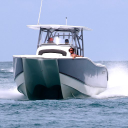
The core strength of Twin Vee Powercats Co. is its proprietary catamaran hull design, which delivers a tangible operational advantage over traditional V-bottom monohulls. This isn't just a marketing slogan; it's physics. The twin-hull geometry significantly reduces the wetted surface area, which cuts down on drag and improves hydrodynamic efficiency.
A key feature is the 'tunnel aeration effect' between the hulls, where air mixes with water to create an air-lift cushion. This reduces pressure drag, allowing the boat to ride higher and achieve a lower planing threshold. What this means for you is less throttle is needed to reach cruising speed, which translates directly into superior fuel economy and a smoother, more stable ride, especially in choppy conditions. This design is the foundation for the 2025 GFX2 model line, which carries a 12-year hull warranty, underscoring confidence in the construction.
Dual-brand strategy with niche Twin Vee and legacy Aquasport appeal.
Twin Vee Powercats Co. has successfully transitioned from a single-brand catamaran builder to a multi-brand marine portfolio, which diversifies revenue streams and market reach. The strategy now encompasses three distinct brands:
- Twin Vee: The core catamaran brand, known for stability and fuel efficiency, appealing to a niche but loyal customer base.
- Aquasport: A legacy monohull brand with a nearly 60-year history, acquired to capture the traditional V-hull fishing boat market.
- Bahama Boat Works: A premium offshore fishing vessel brand, acquired in June 2025, expanding the company into the high-end luxury market.
This multi-brand approach allows the company to appeal to a wider spectrum of financially-literate decision-makers, from the cost-conscious weekend warrior (Aquasport) to the discriminating buyer of a premium offshore vessel (Bahama Boat Works). This is a smart way to de-risk the business model by not relying on a single boat type.
Vertical integration in US manufacturing helps control quality and some costs.
The company's commitment to vertical integration, particularly in its US manufacturing base, is a significant strength for controlling both quality and the cost of goods sold (COGS). The acquisition of the 150,000-square-foot Aquasport manufacturing facility in White Bluff, Tennessee, adds to existing production in Florida and North Carolina.
This control is evident in the manufacturing process for the 2025 model year boats. Twin Vee Powercats Co. now uses 5-Axis CNC router technology for molds and employs composite material infusion for a monolithic hull construction. This level of precision and consistency is difficult to achieve with less integrated, hand-built processes. Simply put, they are building better, more consistent boats.
Strong gross margins on core catamaran models, often exceeding the industry average.
While the recreational marine industry has grappled with inflationary pressures on raw materials like fiberglass and resin, Twin Vee Powercats Co. has demonstrated impressive margin expansion through operational execution and cost control.
For the first half of the 2025 fiscal year, the company achieved substantial sequential improvements in gross margin, which is a clear strength in a challenging market.
Here's the quick math on the 2025 margin recovery:
| Metric | Q1 2025 | Q2 2025 | YoY Change |
|---|---|---|---|
| Revenue (Net Sales) | $3.61 million | $4.8 million | Q2 up 9.9% YoY |
| Gross Margin | 14.9% | 13.8% | Q1 up 961 basis points YoY |
This margin recovery, driven by better manufacturing efficiency and disciplined cost management, shows the company's ability to drive profitability even when facing headwinds. For context, while some diversified industry peers like Marine Products Corporation reported gross margins closer to 19.2% in late 2024, Twin Vee Powercats Co.'s ability to expand its margin by over 900 basis points in the first half of 2025 is a powerful indicator of improving throughput and cost control.
The focus on cost discipline is defintely working.
Finance: Monitor Q4 2025 guidance for continued margin expansion and its comparison to Polaris Industries' marine segment margins.
Twin Vee Powercats Co. (VEEE) - SWOT Analysis: Weaknesses
Small operational scale limits purchasing power and distribution network reach.
You're running a small-cap boat manufacturer in an industry dominated by massive, vertically-integrated players, and that scale difference is a constant headwind. Twin Vee Powercats Co.'s (VEEE) small operational footprint directly limits its ability to negotiate favorable terms for raw materials, which drives up your cost of goods sold (COGS). For the third quarter of 2025, the company reported net sales of only $3.43 million. To put that in perspective, a major competitor like Brunswick Corporation reported consolidated net sales of $1.36 billion for the same quarter. That means Brunswick's quarterly revenue is roughly 396 times the size of Twin Vee's.
This massive disparity in scale impacts everything, including distribution. While the company is actively expanding its dealer network, adding 16 new dealer locations in the first half of 2025, the overall geographic reach and market penetration remain limited compared to the national and global networks of industry leaders. You just can't compete on volume discounts.
Historically high working capital requirements due to inventory and production lead times.
The nature of boat manufacturing means you need significant capital tied up in materials and work-in-progress inventory before a boat is sold and paid for. This creates high working capital demands, which is a major strain for a smaller company with limited cash flow. As of the end of the second quarter of 2025, Twin Vee's working capital stood at $10.2 million. This figure is more than double the entire Q2 2025 revenue of $4.8 million.
The company has had to take direct action to fund this need, including an underwritten public offering in May 2025 that generated $3.0 million in gross proceeds specifically earmarked for working capital and general corporate purposes. While management has improved inventory turnover-field inventory was reduced to under 60 boats by Q1 2025-the underlying capital intensity of the business model remains a significant weakness, creating a persistent need for external financing or asset sales to maintain liquidity.
Reliance on a limited number of key suppliers for critical components.
Like most smaller boat builders, Twin Vee is highly dependent on a few major original equipment manufacturers (OEMs) for critical, high-value components. This is a defintely a weakness because it limits your bargaining power and exposes you to supply chain shocks or price hikes from those few suppliers.
The primary risk centers on two areas:
- Outboard Motors: The company relies on a small pool of engine manufacturers, making it vulnerable to their production schedules, pricing, and allocation decisions.
- Marine Electronics: Key navigation and control systems are sourced from a limited number of specialized tech companies.
The company's own risk disclosures highlight the sensitivity of this supply chain, noting a 'tariff risk to motors/electronics' in their Q1 2025 analysis. This is a clear signal that external trade policy can immediately impact the cost and availability of components that Twin Vee has little leverage to control.
Limited marketing budget compared to larger, established competitors like Brunswick.
Your ability to build brand awareness, launch new models, and drive dealer traffic is severely constrained by a small marketing and sales budget. Twin Vee is forced to operate with extreme cost discipline, which is good for the bottom line but starves the sales engine.
Here's the quick math on the competitive disadvantage:
| Metric | Twin Vee Powercats Co. (VEEE) | Brunswick Corporation (BC) | Difference |
|---|---|---|---|
| Q3 2025 Net Sales | $3.43 million | $1.36 billion | Brunswick is ~396x larger |
| Q3 2025 Operating Expenses | $2.73 million | Not directly comparable (SG&A for 9 months: $822.1 million) | Brunswick's SG&A is orders of magnitude larger |
Twin Vee's total operating expenses (OpEx), which include all selling, general, and administrative costs, were reduced by 8% year-over-year to $2.73 million in Q3 2025. In contrast, Brunswick's Selling, General & Administrative (SG&A) expenses alone for the first nine months of 2025 totaled $822.1 million. This means that for every dollar Twin Vee spends on overhead and marketing, Brunswick can spend hundreds, allowing them to dominate advertising space, boat shows, and key dealer incentives. You're fighting a billboard war with a flyer.
Twin Vee Powercats Co. (VEEE) - SWOT Analysis: Opportunities
Accelerating demand in the electric boat (e-boat) segment with their new models.
You can't ignore the macro trend toward electrification, even if the execution is tricky. The global electric boat market is projected to grow from an estimated $6.78 billion in 2024 to $14.09 billion by 2030, a compound annual growth rate (CAGR) of 13.5%. This market tailwind is driven by consumer demand for quieter, low-maintenance, and eco-friendly options, plus tightening environmental regulations.
To be fair, Twin Vee Powercats Co. made a strategic pivot in 2025, consolidating its electric boat subsidiary, Forza X1, Inc., but ceasing direct electric boat production under that unit to focus on the core business. Still, the opportunity remains in the technology and the brand's catamaran design, which is inherently efficient. The company's prior investment in the electric space means they hold intellectual capital that could be leveraged through licensing or a future, more capital-efficient re-entry when battery costs drop further.
The market is growing fast. You just need to figure out how to re-enter it smarter.
Expanding the dealer network, especially in high-growth coastal US markets.
The company is executing a clear, effective strategy to expand its physical footprint, which directly drives revenue. This is a critical move to capture market share and reduce reliance on any single region or dealer. In the second quarter of 2025, Twin Vee Powercats Co. added 10 new dealer locations, followed by another 14 new dealer locations in the third quarter of 2025.
This expansion targets key coastal US markets where demand for power catamarans and fishing vessels is high. Specific new dealer locations secured in the first half of 2025 include:
- Cape Cod, MA (Goose Hummock)
- Long Island, NY (Patchogue Shores Marina)
- Bradenton, FL and Lake Placid, FL (Boater's World)
- Woodbury Heights, NJ and Wildwood, NJ (NuWave Marine)
Here's the quick math: With 24 new dealer locations added in Q2 and Q3 2025 alone, the company is creating a much broader sales funnel, which contributed to an 18% increase in net sales to $3.43 million in Q3 2025 compared to Q3 2024.
Leveraging the Aquasport brand to capture market share in the monohull segment.
The acquisition of the Aquasport brand in 2023, and the subsequent acquisition of Bahama Boat Works in Q2 2025 for $100,000, positions Twin Vee Powercats Co. to be a serious player in the massive monohull market, which is a different customer base than their core catamaran audience.
The strategy is to fill out the Aquasport line with new models, leveraging its 60-year pedigree to attract traditional center console buyers. New models for the 2025 model year include the Aquasport 280 Super Boat, notable for being the first to adopt Avikus Co., Ltd.'s advanced driver assistance and autonomous boat technology. Furthermore, the company is actively expanding the Bahama Boat lineup, an iconic luxury offshore brand, to include smaller, more accessible models:
- Bahama Boat Works 22-foot model
- Bahama Boat Works 24-foot model
- Bahama Boat Works 28-foot model
This dual-brand approach-Aquasport for the high-volume monohull fishing segment and Bahama Boat Works for the premium offshore market-significantly diversifies their revenue streams and market reach. The Bahama Boat Works acquisition, in particular, commenced customer deliveries in November 2025, marking a successful integration and broader commercial rollout.
Potential for military or commercial contracts due to catamaran stability and efficiency.
While direct military contracts are often unpredictable, the near-term commercial opportunity for Twin Vee Powercats Co. is substantial and actionable. The company is actively marketing the significant tax advantages available to business buyers in late 2025.
Under the federal 'Big Beautiful Bill,' any vessel used 50% or more for business purposes qualifies for 100% first-year depreciation. This is a huge financial incentive for commercial operators, charter companies, and other businesses.
Twin Vee is uniquely positioned to capitalize because their catamaran design is known for superior stability, fuel efficiency, and large deck space, making their 24'-40' models ideal for commercial applications like:
- Charter and transport operations
- Survey and commercial support
- Client entertainment and fishing
The company is touting its fast production and delivery capacity to help buyers secure this 2025 tax benefit before the end of the year, which should defintely drive a spike in commercial sales.
| Commercial Opportunity Metric | 2025 Data / Status | Implication |
|---|---|---|
| Tax Incentive | 100% first-year depreciation (for 50%+ business use) | Dramatically lowers the effective purchase cost for commercial buyers. |
| Target Models | 24'-40' catamaran models | Leverages the core product line's stability and efficiency. |
| Target Commercial Uses | Fishing, transport, charter, and survey | Broadens sales beyond the recreational consumer. |
| Strategic Advantage | Fast production/delivery capacity | Enables buyers to capture the 2025 tax deduction before year-end. |
Twin Vee Powercats Co. (VEEE) - SWOT Analysis: Threats
Economic Slowdown and High Interest Rates Defintely Suppress Consumer Discretionary Spending on Boats
You are operating in a market where the cost of ownership, especially financing, has spiked, and consumers are pulling back on big-ticket purchases. This is a massive headwind for Twin Vee Powercats Co. (VEEE) because a boat is the definition of a discretionary purchase. New powerboat retail unit sales declined by 10.2% year-to-date through May 2025, a clear sign of market softness.
The core issue is the borrowing cost. The average boat loan rate climbed from 4.5% in 2022 to nearly 7.8% in 2025, making monthly payments significantly higher for your customers. For a company that reported a $2.76 million net loss in Q3 2025, this reduced demand directly pressures the top line. Honestly, high rates are a sales killer for any product that requires a long-term loan.
Here's the quick math on how this macro environment translates to VEEE's financial reality as of Q3 2025:
| Metric | Q3 2025 Value | Context of Threat |
|---|---|---|
| Net Sales | $3.43 million | Risk of sales decline in Q4/2026 due to soft consumer sentiment (50.8 in May 2025). |
| Net Loss | $2.76 million | High fixed costs combined with lower unit sales volume mean losses are persistent. |
| Cash & Equivalents (Sept 30, 2025) | $2.92 million | Limited cash buffer to weather a prolonged downturn in discretionary spending. |
Major Competitors Could Enter the Catamaran Market with Superior Capital and Scale
The catamaran segment is growing, projected to reach a market size of $2.23 billion in 2025, but this growth attracts giants. Twin Vee is a smaller, focused player, and while you have a 30-year history in catamarans, you face rivals with immense production capacity and marketing budgets. Larger, established competitors like Groupe Beneteau, Fountaine Pajot, and Sunreef Yachts collectively held a substantial market share of over 13% in 2024 in the broader catamaran industry.
These large players have the capital to invest heavily in new, high-tech designs, electric propulsion systems, and expansive dealer networks that dwarf VEEE's. If one of them decides to aggressively target the mid-size power catamaran market-your core segment-it would immediately squeeze your margins and market share. Your recent strategic move to acquire Bahama Boat Works to enter the premium monohull market is a good diversification, but it also means you are now competing head-to-head with these same large, well-capitalized firms in a new category.
The threat comes from their scale:
- Pricing Power: Larger firms can absorb raw material cost spikes better.
- R&D Budget: They can fund rapid development of new, high-efficiency models.
- Distribution: Their global dealer networks ensure broader market access.
Continued Volatility in Raw Material Costs (e.g., Fiberglass, Resin) Squeezes Production Costs
Your boats are primarily built with fiberglass and resin, and the pricing for these petrochemical-derived materials remains volatile. The global marine fiberglass resin market size is estimated at $2,859.3 million in 2025, and its growth is hampered by fluctuating raw material prices. Raw material price volatility is a noted restraint on market expansion, directly impacting your production costs and profitability margins.
For example, commodity resins like High-Density Polyethylene (HDPE) and Low-Density Polyethylene (LDPE) saw price increases announced in Q2 2025, with one supplier announcing a +5 CPP increase for June 1, 2025. While these are commodity resins, the pricing pressure often ripples across all specialty resin markets, including those used in boat building. Given that Twin Vee's nine-month 2025 gross margin was just 9.6%, any sudden, significant material cost increase could easily push the company back toward a higher gross loss, reversing the Q3 2025 improvement where the gross loss narrowed to $45,000.
Regulatory Changes Impacting Boat Emissions or Safety Standards Could Require Costly Retooling
The regulatory environment is tightening, especially around environmental performance and emissions. While most immediate regulations target large commercial vessels, the trend will inevitably trickle down to recreational boat manufacturers like Twin Vee. The International Maritime Organization (IMO) is pushing for a Net-Zero Framework, with a new chapter in MARPOL Annex VI planned for adoption in October 2025 to introduce a global fuel standard.
Even if VEEE's smaller boats are not directly subject to the largest vessel rules (e.g., those over 5,000 gross tons), the pressure on engine manufacturers to meet stricter standards will increase your procurement costs. The Energy Efficiency Design Index (EEDI) Phase 3, which focuses on strengthening energy efficiency requirements for new ships, entered force for vessels over 400 gross tons in January 2025. This signals a clear regulatory direction toward cleaner, more efficient propulsion.
Any future state-level or federal regulations on recreational boat engine emissions, noise, or safety standards for new boat construction would force costly retooling of your manufacturing process and supply chain. This is a huge risk for a company with limited capital. You need to be defintely monitoring the US Coast Guard's (USCG) development of implementation rules for the EPA's new Vessel Incidental Discharge Act (VIDA) standards, which were finalized in October 2024.
Disclaimer
All information, articles, and product details provided on this website are for general informational and educational purposes only. We do not claim any ownership over, nor do we intend to infringe upon, any trademarks, copyrights, logos, brand names, or other intellectual property mentioned or depicted on this site. Such intellectual property remains the property of its respective owners, and any references here are made solely for identification or informational purposes, without implying any affiliation, endorsement, or partnership.
We make no representations or warranties, express or implied, regarding the accuracy, completeness, or suitability of any content or products presented. Nothing on this website should be construed as legal, tax, investment, financial, medical, or other professional advice. In addition, no part of this site—including articles or product references—constitutes a solicitation, recommendation, endorsement, advertisement, or offer to buy or sell any securities, franchises, or other financial instruments, particularly in jurisdictions where such activity would be unlawful.
All content is of a general nature and may not address the specific circumstances of any individual or entity. It is not a substitute for professional advice or services. Any actions you take based on the information provided here are strictly at your own risk. You accept full responsibility for any decisions or outcomes arising from your use of this website and agree to release us from any liability in connection with your use of, or reliance upon, the content or products found herein.