
San Juan Basin Royalty Trust (SJT) Bundle
How does a publicly traded entity with a $300 million market capitalization, like San Juan Basin Royalty Trust (SJT), manage to deliver a year-to-date total return of nearly 50% as of late 2025, yet simultaneously suspend its monthly distributions? This is not a typical operating company; it's a passive grantor trust whose principal asset is a 75% net overriding royalty interest in oil and gas properties, meaning its fortunes are entirely tied to the net profits-or lack thereof-from the operator, Hilcorp San Juan LP.
While the unit price closed recently at $5.61 on November 21, 2025, reflecting a strong energy market sentiment, the underlying reality is that the Trust has not declared a monthly distribution since May 2024, a direct result of production costs, which hit $21.7 million net to the operator in early 2025, exceeding revenue.
You need to understand this unique structure, because for a royalty trust, the distribution is the whole point, and a 49.87% YTD return that comes with zero recent cash flow is defintely a trade-off worth mapping before you commit capital.
San Juan Basin Royalty Trust (SJT) History
You're looking for a clear-eyed view of San Juan Basin Royalty Trust (SJT)-not just what it is now, but how it got here. The direct takeaway is that SJT is not a traditional operating company but a passive financial vehicle, established to pass through a net profit interest from a single, aging natural gas field. Its history is a story of corporate hand-offs and, more recently, a sharp, near-term financial crisis driven by operator capital spending and low gas prices. You need to understand this passive structure to gauge the risk.
Given Company's Founding Timeline
Year established
The San Juan Basin Royalty Trust was legally established in November 1980.
Original location
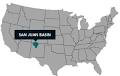
The Trust's principal asset is a 75% net overriding royalty interest (equivalent to a net profit interest) carved out of oil and gas properties located in the San Juan Basin of northwestern New Mexico. The Trust itself is a Texas express trust.
Founding team members
Unlike a startup, SJT was created via a legal indenture between Southland Royalty Company, which conveyed the royalty interest, and The Fort Worth National Bank, which served as the original Trustee. The current Trustee is Argent Trust Company.
Initial capital/funding
The Trust didn't raise capital in the conventional sense. It was formed by conveying an existing asset. The initial carrying value of the Royalty-representing Southland Royalty Company's historical net book value at the transfer date-was $133,275,528.
Given Company's Evolution Milestones
| Year | Key Event | Significance |
|---|---|---|
| 1980 | Trust Established and NYSE Listing | Created a publicly traded, passive vehicle to distribute royalty income to unit holders. |
| 1998 | Southland Royalty Company Merged | Southland merged into Burlington Resources Inc., making Burlington the new successor sponsor of the Trust. |
| 2006 | ConocoPhillips Acquisition | ConocoPhillips acquired Burlington Resources, taking over the role as the Trust's sponsor. |
| 2012 | Hilcorp Energy Becomes Operator | Hilcorp Energy acquired the San Juan Basin properties from ConocoPhillips, becoming the operator responsible for the underlying assets and capital spending. |
| 2024 | Operator Capex Spike | Hilcorp's capital expenditures surged to approximately $33.6 million (from $4.4 million in 2023) to drill two new horizontal wells, creating a large excess production cost deficit. |
| 2025 (Q1) | Distribution Suspension | Excess production costs accrued in 2024 and 2025 led to no distributable income for the first quarter of 2025, and cash distributions were suspended from April 2024 through at least July 2025. |
Given Company's Transformative Moments
The Trust's trajectory has been shaped less by its own actions-it's passive, after all-and more by the corporate shifts of its operators and the geology of its assets. The most transformative decisions were made by the companies that owned the underlying properties, not the Trust itself.
- The Shift to Hilcorp Energy: When Hilcorp Energy became the operator in 2012, it took control of the capital expenditure decisions, which directly impacts the Trust's net profits. This is the single most critical relationship for unit holders.
- The 2024/2025 Capital Expenditure Shock: The operator's decision to dramatically increase capital expenditures in 2024 to approximately $33.6 million (up from $4.4 million in 2023) transformed the Trust's near-term financial health. Here's the quick math: the spending created a cumulative excess production cost deficit of about $12,869,691 net to the Trust as of April 2025, meaning all royalty income was diverted to pay down this deficit, not to unit holders. This is why distributions stopped.
- The 2025 Capex Reduction: Hilcorp's subsequent announcement of a 2025 capital plan of approximately $9.0 million-a 73.5% reduction from the 2024 projected spend-is a defintely necessary course correction, signaling a shift to lower-cost vertical drilling projects to accelerate the repayment of the deficit.
- The Liquidity Strain: The lack of Royalty Income from May 2024 through March 2025 forced the Trust to draw down cash reserves, which stood at just $258,521 as of March 31, 2025, raising substantial doubt about the Trust's ability to continue as a going concern without a quick resumption of royalty payments.
For a deeper dive into how this recent financial strain impacts your investment thesis, you should read Breaking Down San Juan Basin Royalty Trust (SJT) Financial Health: Key Insights for Investors. Finance: Monitor Hilcorp's monthly production reports and the excess cost balance by the first Friday of each month.
San Juan Basin Royalty Trust (SJT) Ownership Structure
San Juan Basin Royalty Trust (SJT) is an unusual entity, operating as a passive grantor trust, not a traditional corporation, so its ownership structure is straightforwardly split between institutional and retail unit holders.
The Trust's governance is fundamentally different from a standard company because it has no employees, officers, or board of directors; all operational control rests with the third-party operator, Hilcorp San Juan LP, and the administrative oversight falls to the appointed Trustee, Argent Trust Company.
San Juan Basin Royalty Trust's Current Status
The Trust is a publicly traded entity, with its Units of Beneficial Interest trading on the New York Stock Exchange (NYSE) under the ticker symbol SJT. It's a passive investment vehicle, meaning the Trustee, Argent Trust Company, is legally restricted from engaging in business or acquiring new properties; it only collects revenue and distributes net proceeds.
As of November 2025, the Trust is under significant financial pressure, having suspended monthly distributions for several consecutive months due to low natural gas prices and a deficit of cumulative excess production costs. The cumulative excess production costs net to the Trust stood at approximately $7,839,016 in November 2025, which must be repaid before distributions can resume. For a deeper dive into the operational goals, you can review the Mission Statement, Vision, & Core Values of San Juan Basin Royalty Trust (SJT).
San Juan Basin Royalty Trust's Ownership Breakdown
With approximately 46.61 million units outstanding as of November 2025, the ownership is heavily weighted toward individual investors and the public float, which is typical for a royalty trust.
Here's the quick math on who holds the units, based on September 2025 filings:
| Shareholder Type | Ownership, % | Notes |
|---|---|---|
| Institutional Investors | 31.99% | Includes hedge funds, mutual funds, and asset managers like Horizon Kinetics Asset Management Llc. |
| Retail/Public Float | 68.01% | The majority of ownership is held by individual investors and non-institutional public shareholders. |
| Insiders | 0.00% | The Trust has no traditional officers or directors, so insider ownership is negligible. |
What this estimate hides is the influence of the largest institutional holders, such as Horizon Kinetics Asset Management Llc, which holds a significant block of shares. Their investment decisions defintely carry weight in the market, even if they don't control the Trust's day-to-day operations.
San Juan Basin Royalty Trust's Leadership
The governance of San Juan Basin Royalty Trust is unique because its structure intentionally separates ownership from operational management. There is no CEO or executive team in the traditional sense; the key decision-making structure involves two primary entities:
- The Trustee: Argent Trust Company. As the Trustee, Argent Trust Company is responsible for the financial administration of the Trust, including collecting the 75% net overriding royalty interest, paying administrative expenses (which totaled $21,200 for September 2025), and distributing net cash to unit holders. They are the public face and legal representative of the Trust.
- The Operator: Hilcorp San Juan LP. This private company is the owner and operator of the underlying oil and gas properties in the San Juan Basin. Hilcorp controls the capital budget and the actual drilling program-like the costly horizontal drilling program in 2024 that led to the current excess cost deficit. The Trust must reimburse Hilcorp for these costs, which is why distributions have been suspended.
The Trustee's administrative office, which handles unitholder inquiries, is located at 3838 Oak Lawn Ave. Suite 1720, Dallas, Texas 75219. The Trustee's primary action now is to monitor the recoupment of the $7.84 million deficit to resume payouts.
San Juan Basin Royalty Trust (SJT) Mission and Values
San Juan Basin Royalty Trust (SJT) is a fixed investment trust, not an operating company, so its mission is purely mechanical: to collect net royalty proceeds from its energy assets and distribute them to you, the unit holder, after expenses. Its core value is a fiduciary one-the faithful execution of the Trust Indenture to maximize distributions over the life of the assets.
Given Company's Core Purpose
The Trust's purpose is not about exploration or growth; it's about income distribution. The Trustee, Argent Trust Company, is legally restricted from engaging in any business or commercial activity, and they cannot acquire additional properties. This structure means the Trust's existence is tied entirely to the production from its existing properties in the San Juan Basin of New Mexico.
Here's the quick math: when the operator, Hilcorp San Juan L.P., sells oil and gas, the Trust receives a 75% net overriding royalty interest-a share of the net profits. That's the only game in town.
- Collect net proceeds from the sale of oil and gas.
- Deduct administrative expenses and maintain cash reserves.
- Distribute the remainder as monthly income to unit holders.
Official Mission Statement
A formal, marketing-style mission statement does not exist for San Juan Basin Royalty Trust. Its mission is defined by the 1980 Trust Indenture, which mandates a singular focus on passive income generation for its unit holders.
To be fair, the current financial reality highlights this mission's limits. For the three months ended March 31, 2025, the Distributable Income was $0, a sharp drop from $4.1 million in the same period of 2024, due to increased capital expenditures by Hilcorp and lower natural gas prices. The mission is clear, but its execution depends entirely on external factors.
Vision Statement
The Trust's vision is inherently finite and non-expansive. It cannot buy new assets, so its long-term outlook is simply to continue providing distributions until the underlying oil and gas reserves are depleted. The Trust's vision is one of consistent, albeit depleting, cash flow.
The immediate vision, however, is to stabilize its cash position. As of April 2025, the Trust was applying net proceeds to a balance of excess production costs, which stood at approximately $12,869,691 net to the Trust, preventing royalty income from flowing to the Trustee. The Trustee's near-term vision is to replenish the cash reserves to $2.0 million to cover administrative expenses.
If you want a deeper dive into the operational risks tied to this vision, you should read Breaking Down San Juan Basin Royalty Trust (SJT) Financial Health: Key Insights for Investors.
Given Company slogan/tagline
Since San Juan Basin Royalty Trust is a trust, it doesn't use a slogan. But if I had to sum up its role in one clean one-liner, it would be: 'A passive stake in the San Juan Basin's energy output.'
The functional taglines that reflect its purpose are:
- Delivering a net overriding royalty interest.
- Fixed assets, passive income.
The price per unit, which closed at $5.61 on November 21, 2025, defintely reflects the market's current assessment of this finite vision.
San Juan Basin Royalty Trust (SJT) How It Works
The San Juan Basin Royalty Trust (SJT) is a passive, publicly traded trust that doesn't operate any energy assets; it simply collects and distributes royalty income from a single, defined set of oil and natural gas properties in the San Juan Basin of New Mexico. The trust's value creation is entirely dependent on the production volumes and commodity prices realized by the operator, Hilcorp San Juan LP, for its underlying Subject Interests.
Given Company's Product/Service Portfolio
The trust's core offering to its Unit Holders is a direct, passive economic interest in the net proceeds from hydrocarbon production, primarily natural gas. This structure is a 75% net overriding royalty interest (equivalent to a net profit interest) carved out of the operator's leasehold and royalty interests in the basin.
| Product/Service | Target Market | Key Features |
|---|---|---|
| Natural Gas Royalty Interest | Income-focused energy investors, financial institutions, portfolio managers | Provides direct exposure to natural gas prices; accounted for approximately $4.61 million of the Subject Interests' revenue in September 2025. |
| Oil Royalty Interest | Income-focused energy investors, financial institutions, portfolio managers | Secondary income stream providing diversification; accounted for approximately $117,131 of the Subject Interests' revenue in September 2025. |
Given Company's Operational Framework
The operational process is straightforward but currently constrained by a substantial cumulative deficit. The Trustee, Argent Trust Company, has a non-operating role; its main function is to collect the net proceeds attributable to the Royalty and make monthly distributions to Unit Holders after deducting administrative costs and maintaining cash reserves. It's a clean model, but the trust has no control over the capital expenditure (CAPEX) or drilling decisions of the operator, Hilcorp San Juan LP. That's a huge limit.
Here's the quick math on the current hurdle: Distributions are halted as of November 2025 because the net proceeds are being applied to a cumulative excess production cost balance, which is approximately $7,839,016 net to the Trust. Plus, the Trust must repay an outstanding Line of Credit balance of about $306,674 and replenish its cash reserve to $2.0 million before any payouts resume.
- Revenue Collection: Hilcorp San Juan LP reports gross revenues ($4.73 million in September 2025) and production costs ($3.55 million in September 2025) to the Trust monthly.
- Deficit Application: Net proceeds are currently applied to the cumulative excess production cost deficit-a result of prior CAPEX, including Hilcorp's 2024 horizontal drilling.
- Administrative Costs: Trust administrative expenses, such as the $21,200 incurred in September 2025, are paid from cash reserves or the Line of Credit during revenue shortfalls.
For a deeper dive into the numbers, check out Breaking Down San Juan Basin Royalty Trust (SJT) Financial Health: Key Insights for Investors. Defintely a necessary read right now.
Given Company's Strategic Advantages
The trust's advantages stem from its simplicity and the nature of its underlying asset, though its passive structure is also its greatest risk in a low-price environment. It offers a direct, unhedged play on the price of natural gas and oil.
- Established Asset Base: The trust holds an interest in a mature, established production area in the San Juan Basin, which reduces the exploration risk associated with typical upstream companies.
- Zero Operational Risk: Unit Holders are shielded from the direct financial and environmental liabilities of operating the wells, as this is solely the responsibility of the operator, Hilcorp San Juan LP.
- Low Administrative Overhead: As a passive entity, the Trust's administrative expenses are relatively low compared to an operating company, totaling only $21,200 for the September 2025 production month.
- Direct Commodity Exposure: The royalty interest provides a pure-play investment vehicle whose distributable cash flow is a function of commodity prices and production volume, with the September 2025 average gas price at $2.09 per Mcf.
What this simplicity hides is that the Trust cannot strategically invest to mitigate production declines or low prices, making it entirely reliant on Hilcorp's 2025 CAPEX plan of $9.0 million for 29 projects to boost future net proceeds. The Trust is a price taker, not a price maker.
San Juan Basin Royalty Trust (SJT) How It Makes Money
San Juan Basin Royalty Trust (SJT) is not an operating company; it's a passive entity that makes money by collecting monthly net proceeds (Royalty Income) from a 75% net overriding royalty interest in specific oil and natural gas properties in the San Juan Basin of New Mexico. This means the Trust gets a slice of the profits, not the gross revenue, after the operator, Hilcorp San Juan L.P., deducts production costs and capital expenditures.
You're essentially investing in a stream of income from an energy asset, but that stream is highly volatile and currently blocked by a significant debt hurdle.
San Juan Basin Royalty Trust's Revenue Breakdown
The Trust's revenue is derived almost entirely from the sale of natural gas and oil from the underlying properties, with natural gas being the dominant commodity. Based on the operator's (Hilcorp San Juan L.P.) total revenue from the Subject Interests for the production month of August 2025, the breakdown is clear.
| Revenue Stream | % of Total (Gross Proceeds) | Growth Trend (Underlying Asset) |
|---|---|---|
| Natural Gas Revenue | 97.05% | Increasing |
| Oil Revenue | 2.95% | Stable |
Here's the quick math: For August 2025, the Subject Interests generated total revenue of $5,384,015, with gas revenues at $5,225,259 and oil revenues at $158,756. The underlying asset's gross proceeds are on an Increasing trend, up 50% for the nine months ended September 30, 2025, year-over-year, driven by higher production volumes and better natural gas prices.
Business Economics
The core economic engine of San Juan Basin Royalty Trust is its net overriding royalty interest (NPI), which is a key distinction from a gross royalty. This structure means the Trust's income is the net profit from the production, making it directly vulnerable to the operator's costs.
- Net Profit Interest: The Trust receives a royalty based on gross proceeds minus all operating expenses, production taxes, and capital expenditures incurred by the operator, Hilcorp San Juan L.P.
- Pricing Sensitivity: The royalty income is highly correlated with the price of natural gas. For example, the average realized natural gas price for the Subject Interests rose to $2.11 per Mcf in Q3 2025, a 42% year-over-year increase, but this still wasn't enough to clear the cost hurdle.
- Cost Hurdle (Excess Production Costs): The most critical factor is the Excess Production Cost (EPC) balance. This occurs when the operator's costs and capital expenditures exceed the gross proceeds. The net proceeds that would normally be paid to the Trust are instead applied to reduce this cumulative deficit.
This is a passive investment, so the Trust has no control over the production volumes, operating costs, or capital spending decisions made by Hilcorp San Juan L.P. That lack of control is defintely a major risk factor.
San Juan Basin Royalty Trust's Financial Performance
The Trust's financial performance as of late 2025 is defined by a significant bottleneck: the inability to receive Royalty Income and, consequently, the suspension of distributions to Unit Holders. The underlying production is strong, but the legacy costs are a heavy drag.
- Zero Royalty Income: The Trust has not received any Royalty Income since May 2024 because all net proceeds have been applied to the EPC balance.
- Excess Production Cost (EPC) Balance: As of October 2025, the cumulative EPC balance net to the Trust was approximately $8,722,969. This deficit must be paid off entirely before distributions can resume.
- Q3 2025 Results: For the nine months ended September 30, 2025, the Trust reported a net loss of $274,135 on minimal revenue of only $11,608, reflecting the lack of Royalty Income.
- Distribution Hurdles: To resume cash distributions, the Trust must clear three hurdles: 1) fully repay the net EPC balance (approx. $8.72 million); 2) replenish the mandated cash reserve to $2,000,000; and 3) repay the outstanding principal and interest on its Line of Credit (approx. $293,440 as of October 2025).
The business model is simple-collect net profits-but the current financial reality is complex, requiring over $11 million in future net proceeds just to get back to a distributable state. You can dive deeper into the implications of this financial strain in Breaking Down San Juan Basin Royalty Trust (SJT) Financial Health: Key Insights for Investors.
San Juan Basin Royalty Trust (SJT) Market Position & Future Outlook
San Juan Basin Royalty Trust (SJT) currently occupies a precarious, micro-cap position in the energy royalty sector, valued at approximately $279 million as of November 2025. Its future trajectory hinges entirely on the success of its operator's $9.0 million capital plan and a significant recovery in natural gas prices, as the Trust is not receiving royalty income due to a substantial deficit.
Competitive Landscape
Compared to its peers, SJT is a small, high-risk, natural gas-focused trust. Its market capitalization is dwarfed by its competitors, which generally offer more diversified or oil-weighted portfolios, a key factor in the current market. Here's the quick math on relative market share within a peer group of major royalty trusts:
| Company | Market Share, % | Key Advantage |
|---|---|---|
| San Juan Basin Royalty Trust | 8.2% | Potential upside from new vertical drilling in a legacy gas basin. |
| Sabine Royalty Trust (SBR) | 33.2% | Diversified oil and gas assets; consistent distributions. |
| Dorchester Minerals LP (DMLP) | 33.0% | Strong oil exposure in the Permian Basin; high distribution coverage. |
| Permian Basin Royalty Trust (PBT) | 25.6% | Oil-weighted Permian Basin exposure; less reliance on natural gas. |
Opportunities & Challenges
The Trust is effectively in a holding pattern, with all net proceeds being applied to recover a prior deficit. The entire investment thesis rests on the operator's activity finally turning a corner.
| Opportunities | Risks |
|---|---|
| Natural Gas Price Recovery: Prices need to stabilize near $4.50/MMBtu to offset costs and generate distributable income. | 'Going Concern' Risk: Financial statements include a warning about the Trust's ability to continue operations. |
| Deficit Repayment: Repaying the cumulative $12.87 million (net to the Trust) in excess production costs will allow distributions to resume. | Low Gas Prices: Natural gas prices hovering around $3.41/MMBtu (July 2025) are insufficient to cover costs and generate a profit. |
| Production Stabilization: The operator's 2025 capital plan of $9.0 million is targeted to boost production from 1.7 Bcf/d to an estimated 2.0 Bcf/d by year-end. | Passive Structure: The Trust has no control over the operator's (Hilcorp Energy) spending or drilling strategy. |
Industry Position
San Juan Basin Royalty Trust's industry standing is that of a micro-cap, single-basin, natural gas-heavy royalty trust facing significant headwinds. Its passive structure is a major limiting factor; it cannot acquire new, more profitable properties or diversify its asset base like its larger competitors.
- The Trust's Q1-Q3 2025 revenue was only $11,608, a sharp drop from the prior year, reflecting the application of proceeds to the deficit.
- The operator's shift to lower-cost vertical drilling in the Dakota/Mesaverde formations, as part of the $9.0 million capital plan, is a more conservative approach than the high-cost horizontal drilling of 2024.
- The current lack of distributions (suspended since July 2025) and the need to replenish cash reserves to $2.0 million before payments resume places it far behind peers like Sabine Royalty Trust and Dorchester Minerals LP.
To be fair, the new capital plan could lead to a production surge, but the risk of a total loss of investment principal is defintely elevated until the deficit is cleared. For a deeper dive into the governance, see Mission Statement, Vision, & Core Values of San Juan Basin Royalty Trust (SJT). Finance: track deficit repayment progress monthly via SEC filings.
San Juan Basin Royalty Trust (SJT) DCF Excel Template
5-Year Financial Model
40+ Charts & Metrics
DCF & Multiple Valuation
Free Email Support
Disclaimer
All information, articles, and product details provided on this website are for general informational and educational purposes only. We do not claim any ownership over, nor do we intend to infringe upon, any trademarks, copyrights, logos, brand names, or other intellectual property mentioned or depicted on this site. Such intellectual property remains the property of its respective owners, and any references here are made solely for identification or informational purposes, without implying any affiliation, endorsement, or partnership.
We make no representations or warranties, express or implied, regarding the accuracy, completeness, or suitability of any content or products presented. Nothing on this website should be construed as legal, tax, investment, financial, medical, or other professional advice. In addition, no part of this site—including articles or product references—constitutes a solicitation, recommendation, endorsement, advertisement, or offer to buy or sell any securities, franchises, or other financial instruments, particularly in jurisdictions where such activity would be unlawful.
All content is of a general nature and may not address the specific circumstances of any individual or entity. It is not a substitute for professional advice or services. Any actions you take based on the information provided here are strictly at your own risk. You accept full responsibility for any decisions or outcomes arising from your use of this website and agree to release us from any liability in connection with your use of, or reliance upon, the content or products found herein.